Pune is one of India's largest IT hubs, but securing a job requires more than just academic knowledge. The right Java Full Stack training bridges the gap between college and the corporate world by teaching you exactly what companies need: modern frameworks, practical coding skills, and interview readiness.
Why Java Full Stack Is One of the Most In-Demand Careers
The software industry in Pune, spanning from Kothrud to Hinjewadi and Kharadi, is actively hiring. However, companies are moving away from hiring separate frontend and backend developers for junior roles. They want Full Stack Developers—professionals who can build a complete application from the database up to the user interface.
Java remains the absolute backbone of enterprise software. From global banking systems to massive e-commerce platforms, Java is everywhere. Combining the robust backend power of Java with modern frontend technologies makes you an incredibly valuable asset in the 2026 job market.
How to Choose the Best Java Full Stack Training Institute in Pune
With hundreds of offline Java classes in Pune and Maharashtra, selecting the right one can be overwhelming. Making the wrong choice costs time, money, and career momentum. Use this framework to evaluate any institute:
Things Every Student Must Check Before Joining Any Institute
-
Trainer Pedigree: Are you being taught by an academic teacher or an industry professional? You need someone who knows how code behaves in a production environment.
-
Syllabus Relevance: If an institute focuses only on Core Java and basic HTML, run. You must learn Spring Boot, Microservices, and modern JavaScript libraries.
-
Project-Based Learning: Copying code from a whiteboard isn't coding. Ensure the course demands building independent, real-world projects from scratch.
-
Placement Reality vs. Fiction: Beware of verbal "100% guarantees." Look for robust placement assistance that includes resume building, aptitude training, and direct scheduling of interviews.
Comparison Table: Average vs. Premium Institute
| Feature | Average Training Center | Premium IT Institute |
| Curriculum | Outdated (Applets, JSP heavy) | Modern (Spring Boot, React, Microservices) |
| Trainers | Academic only | Experienced Software Developers |
| Practical Work | 80% Theory / 20% Practical | 30% Theory / 70% Hands-on Coding Practice |
| Projects | Basic calculators | End-to-end Enterprise Applications |
| Career Support | Just forwarding resumes | Mock Interviews, LinkedIn Optimization, Soft Skills |
What Makes a Good Java Full Stack Course?
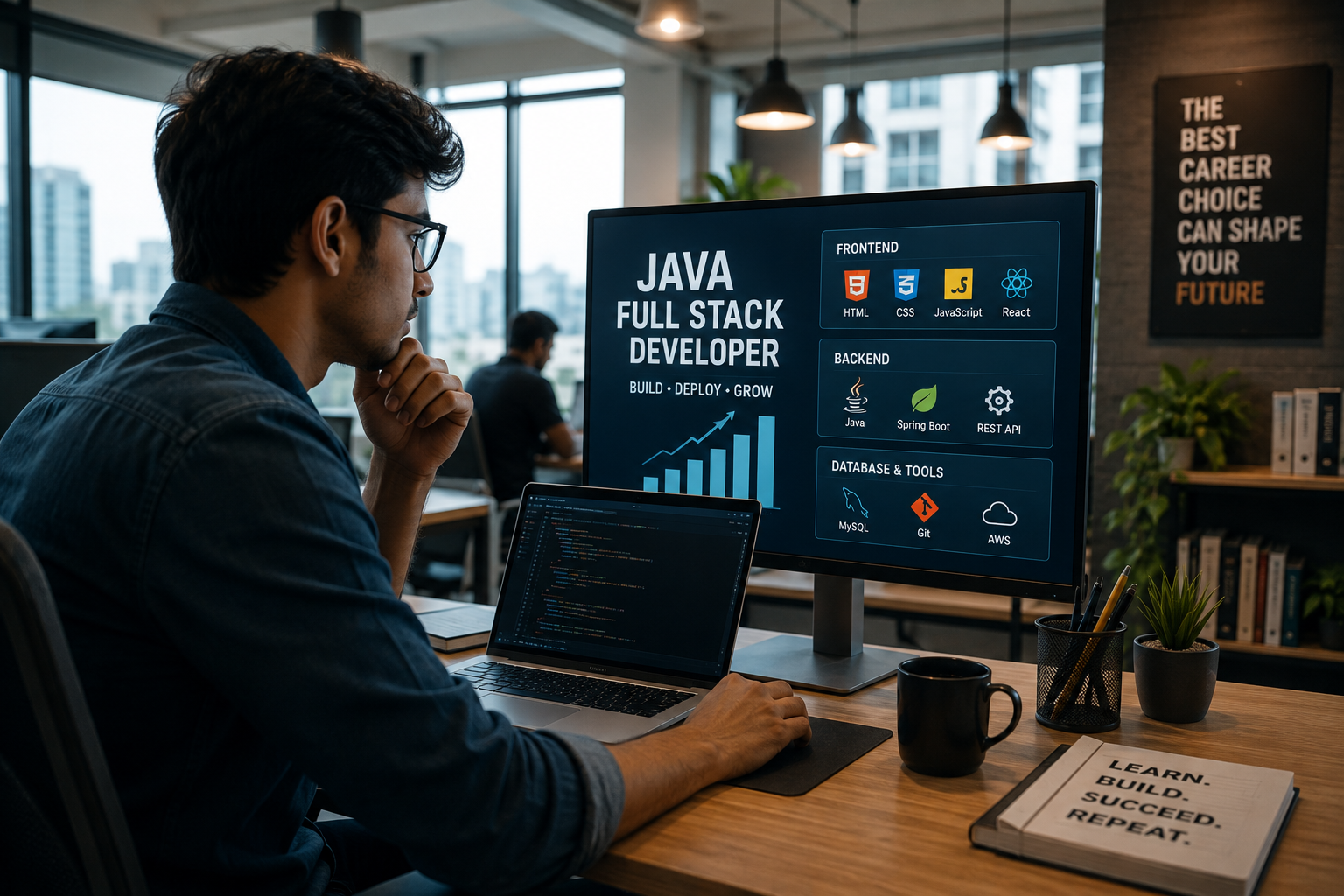
A premium Java Full Stack Course must cover the complete lifecycle of application development. Here are the industry skills companies expect:
The Backend Engine
-
Core Java & Advanced Java: The foundation of object-oriented programming, data structures (DSA), multithreading, and collections.
-
Java 8+ Features: Utilizing modern syntax like Lambda expressions and Streams.
-
Spring & Spring Boot: The industry standard for building scalable Java applications quickly.
-
Hibernate: Managing database connections efficiently using Object-Relational Mapping (ORM).
-
REST API & Microservices: Building the communication endpoints that modern applications rely on.
The Database
-
SQL (MySQL/PostgreSQL): Writing efficient queries, joins, and understanding relational database design.
The Frontend Interface
-
Web Basics: HTML, CSS, and modern JavaScript (ES6+).
-
React (or Angular): Building fast, responsive Single Page Applications that users love.
DevOps & Tools
-
Git & GitHub: Essential version control for working in teams.
-
Maven: Managing project dependencies and builds.
How VibrantMinds Technologies Helps Students Become Job Ready
When searching for the Best Java Full Stack Training Institute in Pune, particularly for students nearby Warje, Kothrud, and surrounding areas, VibrantMinds Technologies Pvt. Ltd. consistently stands out.
VibrantMinds doesn't just run a coding class; they operate a comprehensive career launchpad. With a stellar 4.9 rating from over 900 reviews on Justdial, their focus is on transforming freshers into competent, interview-ready IT professionals.
Here is why students trust the VibrantMinds approach:
-
Industry-Aligned Curriculum: The syllabus is constantly updated to match what companies in Pune are actively asking for in interviews, covering everything from Core Java to Spring Boot and REST APIs.
-
Expert Mentorship: Training is delivered by professionals who bring real corporate experience and case studies into the classroom.
-
Hands-on Learning: Theory is immediately followed by rigorous coding practice and industry assignments.
-
Dedicated Placement Assistance: VibrantMinds is renowned for its placement support. They don't just teach; they prepare you. This includes intensive Mock Interviews, Aptitude training, Soft Skills development (including Spoken English and Group Discussions), and Resume Building.
Student Learning Journey at VibrantMinds:
Logic Building → Core Backend (Java) → Database Mastery (SQL) → Modern Frameworks (Spring Boot) → Frontend Technologies → Real-world Projects → Interview Preparation (Aptitude & Soft Skills) → Placement Drives.
Career Opportunities and Salary Trends After Java Full Stack
Completing a rigorous Java Full Stack course opens doors to multiple roles:
-
Backend Java Developer
-
Frontend Developer
-
Full Stack Engineer
-
Software Development Engineer (SDE)
Salary Expectations in Pune: Freshers with strong project portfolios and modern framework knowledge can expect starting packages ranging from ₹3.5 LPA to ₹7 LPA, depending on the tier of the hiring company and the candidate's performance in coding rounds.
Common Mistakes Students Make (Expert Tips)
-
Ignoring the Frontend: Don't assume you only need Java. A true full-stack developer understands how the frontend consumes their backend APIs.
-
Skipping Daily Practice: You cannot read a book to learn coding. You must write code every single day.
-
Underestimating Aptitude Tests: Many top MNCs eliminate 70% of candidates in the first aptitude round. If you don't practice logic and math, your coding skills won't matter.
-
No GitHub Portfolio: A resume without a link to your live projects and GitHub repositories is easily ignored by HRs.
Quick Checklist Before Joining
Before you finalize your admission for offline Java Full Stack training, ensure you have ticked these boxes:
-
[ ] Does the syllabus include Spring Boot and Microservices?
-
[ ] Will I learn modern frontend technologies?
-
[ ] Are the trainers experienced IT professionals?
-
[ ] Will I build and host real-world projects?
-
[ ] Does the institute provide structured mock interviews and aptitude training?
If you want an institute that checks all these boxes, reaching out to VibrantMinds Technologies Pvt. Ltd. is your best next step.
FAQs
1. Is Java Full Stack a good career choice in 2026?
Absolutely. Java is the backbone of most large-scale enterprise applications. The demand for developers who can handle both the backend (Spring Boot) and frontend continues to grow rapidly.
2. Can a non-IT background student learn Java Full Stack?
Yes. While it requires dedication, premium institutes start from the absolute basics of logic building, making it accessible for students from Mechanical, Civil, or Commerce backgrounds.
3. Why is Spring Boot so important?
Spring Boot drastically reduces the configuration time needed to set up a Java application. It is the absolute industry standard, and knowing it is often a mandatory requirement for Java developer roles.
4. How important are live projects?
They are critical. Live projects prove to employers that you can apply theoretical knowledge to solve real problems. They form the core of your technical interview discussions.
5. What is the difference between Core Java and Advanced Java?
Core Java covers the fundamental concepts (OOP, collections, threading) necessary to write basic programs. Advanced Java deals with enterprise-level concepts like database connectivity and web technologies.
6. Do I need to learn SQL if I am a Java developer?
Yes. Every enterprise application stores data. You must know how to write SQL queries to interact with databases effectively.
7. How does VibrantMinds Technologies help with placements?
VibrantMinds provides comprehensive placement assistance, which includes technical training, soft skills workshops, aptitude preparation, resume optimization, and arranging interview opportunities with hiring companies.
8. Why are mock interviews necessary?
Mock interviews help you practice articulating your thoughts under pressure. They identify your weak points in communication and technical knowledge before you face a real HR or technical panel.
9. How long does it take to complete the course?
A comprehensive Java Full Stack training program typically takes between 4 to 6 months, depending on the depth of the curriculum and project work.
10. Is offline training better than online?
For freshers, offline training in Pune (like in Warje or Kothrud) is often highly beneficial as it provides an immersive environment, immediate doubt resolution, and excellent peer networking.
11. What is the role of GitHub in a developer's career?
GitHub acts as your digital resume. It showcases your actual code, your commit history, and your ability to use version control—all of which are highly attractive to recruiters.
12. Does VibrantMinds offer career guidance?
Yes, career guidance is a core component. They mentor students on market trends, interview strategies, and how to position themselves as job-ready candidates.
Disclaimer: Course curriculums, placement statistics, and industry requirements are subject to change. Students are advised to verify all details directly with VibrantMinds Technologies Pvt. Ltd. prior to enrollment.