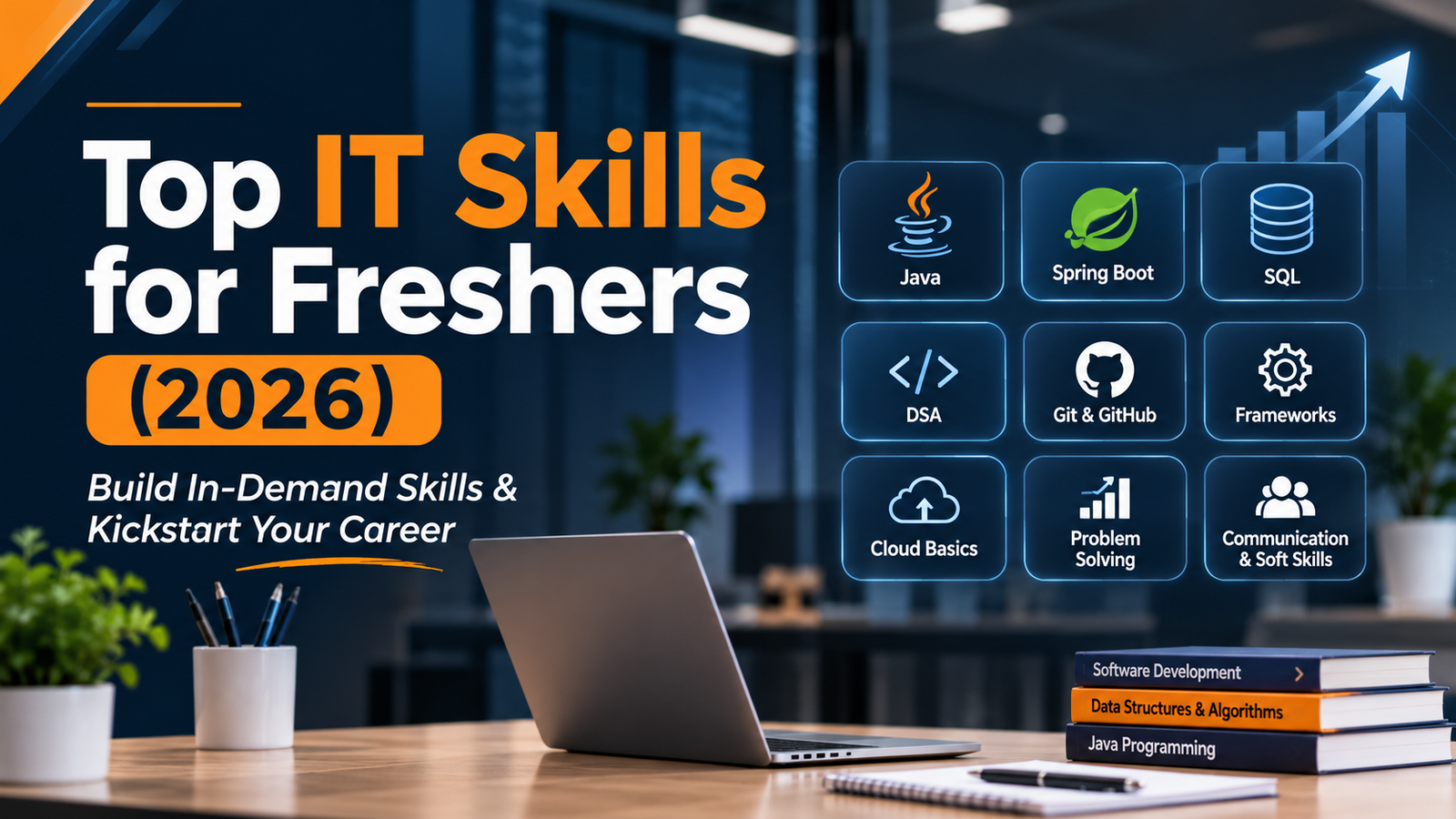
Which IT skills should a fresher learn to get a job in 2026? Build skills in three layers: (1) one core language (Java or Python) with SQL, (2) the working tools every team uses (Git and GitHub, APIs, debugging, basic Linux), and (3) career skills (problem solving, communication, aptitude and the ability to learn quickly, including using AI tools wisely). Then prove each skill with a small project, a GitHub repository or a test document. Depth in a few skills beats a long list of half-learned ones.
This guide from VibrantMinds Technologies in Pune explains the top IT skills for freshers in plain language: what to learn first, what to learn next, what to skip for now, which skills match which job role (Java developer, Python and data, software tester, support), how to prove each skill and a 90-day plan. It is written for anyone searching top IT skills for freshers, IT skills in demand for freshers 2026, skills required for IT jobs for freshers, best skills to learn for a job after graduation, technical skills for freshers, soft skills for IT freshers, skills for Java developer freshers, skills needed for software tester fresher, job-ready skills for freshers or a free IT job WhatsApp group for freshers in Pune.
KEY TAKEAWAYS (READ THIS FIRST)
| Takeaway | Detail |
|---|---|
| Pick one path first | Java developer, Python and data, testing or support. Don’t learn everything at once. |
| Core language plus SQL is the base | Most fresher IT roles test programming logic and database basics. |
| Git and APIs make you look job-ready | Teams expect a fresher to read code, use version control and understand how apps talk. |
| Career skills decide close calls | Communication, aptitude and problem solving often separate similar candidates. |
| Prove every skill | A project, a GitHub repository or a document beats a line in your skills list. |
| Depth beats breadth | Five skills you can explain beat fifteen you can’t. |
| Use AI as a helper, not a crutch | Understand every line you submit. |
THE THREE-LAYER SKILL MODEL
LAYER 3   CAREER SKILLS      → problem solving · communication · aptitude · learning speed
             ▲
LAYER 2   WORKING TOOLS      → Git/GitHub · APIs · debugging · Linux · testing basics
             ▲
LAYER 1   CORE TECHNICAL     → one language (Java or Python) · SQL · OOP · data structures basics
Build from the bottom. A strong Layer 1 makes Layers 2 and 3 much easier. A weak Layer 1 can’t be fixed by a long list of Layer 2 tools.
LAYER 1: CORE TECHNICAL SKILLS
| Skill | What “good enough for a fresher” means | How to prove it |
|---|---|---|
| One programming language (Java or Python) | Variables, conditions, loops, functions, strings, arrays and collections. Solve basic problems without help. | 25 solved programs and one project |
| Object-oriented programming | Classes, objects, inheritance, polymorphism, encapsulation, abstraction with a real example | A small project using clear classes |
| SQL and databases | Create tables, write joins, GROUP BY, subqueries, understand keys |
A project with a real database schema |
| Data structures and logic basics | Arrays, strings, lists, maps, sets, basic sorting and searching | Practice problems with explanations |
| Basic web knowledge | HTML, CSS, JavaScript basics and how a browser talks to a server | A small web page or app |
Java path: Core Java, OOP, collections, exceptions, JDBC, SQL, then Spring Boot.
Python path: Python basics, OOP, file handling, SQL, then Pandas for data or Flask/FastAPI for web.
LAYER 2: WORKING TOOLS EVERY TEAM USES
| Skill | What to know | Why employers care |
|---|---|---|
| Git and GitHub | Clone, branch, commit, push, pull requests, merge conflicts | Every team uses version control |
| APIs and REST | HTTP methods, status codes, JSON, building and testing a simple API with Postman | Modern apps are built on APIs |
| Debugging and reading errors | Read a stack trace, use breakpoints, fix common exceptions | You’ll spend much of your time fixing and understanding code |
| Basic Linux commands | Navigate, read logs, permissions, processes | Servers and containers commonly use Linux |
| Testing basics | Test cases, unit tests (JUnit or pytest), bug reports | Quality is everyone’s job |
| Frameworks for your path | Spring Boot (Java), Pandas or FastAPI (Python), Selenium (testing) | Shows you can build real things |
| Docker basics (bonus) | Dockerfile, run a container, Docker Compose | Increasingly common in project setups |
| Cloud basics (bonus) | What cloud services are and one simple deployment | Awareness helps, depth is not expected from freshers |
LAYER 3: CAREER SKILLS THAT DECIDE OFFERS
Technical skills open the door. These skills help you walk through it.
| Skill | What it looks like in practice | How to build it |
|---|---|---|
| Problem solving | Break a problem into steps, try an approach, test, improve | Solve problems aloud and explain your steps |
| Communication | Clear self-introduction, simple explanations, polite emails | Practise explaining one concept in 60 seconds daily |
| Aptitude and reasoning | Quantitative, logical and verbal sections in online tests | 45 minutes of timed practice daily |
| Learning speed | Pick up a new tool from documentation | Learn one small tool a month and note what you learned |
| Teamwork and ownership | Take responsibility, ask good questions, share updates | Build one project with a friend using GitHub |
| Time management | Plan work, meet deadlines | Use a weekly study plan and track it |
| Professional habits | Punctuality, honesty, accepting feedback | Treat practice like a job |
| Using AI tools responsibly | Use AI to explain, review and speed up, then verify and understand | Ask AI to explain errors, then rewrite the fix yourself |
On communication: many freshers underestimate it. A candidate who explains a project clearly often does better in interviews than one with more skills who can’t explain them.
SKILLS BY JOB ROLE
| Role | Core skills | Tools | Career skills to stress |
|---|---|---|---|
| Java developer / Java full stack | Core Java, OOP, collections, SQL, Spring Boot, REST APIs, HTML/CSS/JavaScript | Git, Maven, Postman, IDE debugger | Problem solving, project explanation |
| Python developer | Python, OOP, SQL, Flask or FastAPI | Git, virtual environments, Postman | Clean code, learning speed |
| Data analyst (entry level) | Python or Excel, SQL, Pandas, basic statistics, charts | Jupyter, Excel, a dashboard tool | Explaining insights simply |
| Software tester (manual + automation) | Test design, STLC, bug reporting, SQL, basics of Java or Python, Selenium | Jira (or similar), Postman, Git | Attention to detail, clear writing |
| Technical support / application support | Troubleshooting, SQL basics, Linux basics, ticketing, networking basics | Ticketing tools, log reading | Communication, patience, availability for shifts |
| Front-end developer (junior) | HTML, CSS, JavaScript, a framework such as React | Git, browser dev tools | Attention to design and detail |
Choose the row that matches the jobs you’re applying for. Then read those job descriptions and mirror their skill lists honestly.
SKILL PRIORITY LADDER: MUST-HAVE, SHOULD-HAVE, BONUS
BONUS          Docker basics · cloud basics · CI/CD awareness · a second language
SHOULD-HAVE    Git/GitHub · REST APIs · debugging · basic Linux · testing basics · a framework
MUST-HAVE One core language · OOP · SQL · logic and problem solving · communication · aptitude| Tier | Rule |
|---|---|
| Must-have | Don’t apply broadly until these feel solid. |
| Should-have | Add them next. They make your projects and interviews stronger. |
| Bonus | Learn after the first two tiers. They add value but don’t replace the basics. |
What to skip for now: learning five programming languages at once, advanced topics before basics, tool-collecting without projects, and trending technologies you can’t explain.
HOW MUCH IS ENOUGH? THE “JOB-READY” TEST
You’re close to job-ready when you can honestly say yes to most of these:
| Test | Yes / No |
|---|---|
| I can solve basic coding problems in my language without copying | |
I can write SQL joins and GROUP BY queries from memory |
|
| I can explain OOP with one real example | |
| I have 2 finished projects on GitHub with READMEs | |
| I can explain one project in 90 seconds, including a bug I fixed | |
| I can read an error message and find the first line of my own code | |
| I can use Git to branch, commit and open a pull request | |
| I can introduce myself clearly in 60 seconds | |
| I can solve basic aptitude questions within the time limit | |
| I know which role I’m targeting and why |
Eight or more yeses is a strong position to start applying actively. Fewer means you know exactly what to work on.
LEARN IT, BUILD IT, PROVE IT
A skill only counts when someone can see it. Use this three-step loop for every skill.
LEARN  →  BUILD  →  PROVE
(study) (use it) (show it)| Skill | Build | Prove |
|---|---|---|
| Core language | 25 practice programs | A GitHub repository of solved problems |
| SQL | A database for a small app, with 20 practice queries | A SQL file and an ER diagram in your repository |
| Spring Boot or Flask | A CRUD API with validation | A README, Postman collection and screenshots |
| Git and GitHub | Daily commits on a project, a pull request | A clean commit history |
| Testing | Test cases for a login page and a registration form | A test case sheet and bug reports |
| Debugging | Fix 5 intentional bugs | A “bugs I fixed” section in your README |
| Linux | Run your app on Linux and read its logs | A short notes file with commands you used |
| Communication | Record yourself explaining a project | A rehearsed 90-second pitch |
| Docker (bonus) | Containerise one project | A Dockerfile and Compose file in the repository |
HOW TO SHOW SKILLS ON A FRESHER RESUME
| Do | Don’t |
|---|---|
| Group skills by type (Languages, Databases, Tools, Frameworks) | Dump 30 keywords in one line |
| List only what you can discuss | List tools you touched once |
| Link GitHub and live demos | List skills with no proof |
| Show skills in project bullets (“Built a REST API with Spring Boot and MySQL”) | Use vague words like “good knowledge of programming” |
| Match keywords from the job description honestly | Copy a job description’s skills you don’t have |
Example skills section
Languages:   Java, SQL, HTML, CSS, JavaScript (basic)
Frameworks:  Spring Boot, Spring Data JPA
Databases:   MySQL
Tools:       Git, GitHub, Maven, Postman, IntelliJ IDEA
Concepts:    OOP, REST APIs, JUnit testing, debugging
HOW TO READ A JOB DESCRIPTION FOR SKILLS
| Step | What to do |
|---|---|
| 1. Highlight must-haves | Words like “required” or “must” |
| 2. Highlight nice-to-haves | Words like “preferred” or “plus” |
| 3. Count repeated skills | Skills mentioned across many fresher jobs are priorities |
| 4. Compare with your list | Mark what you have, what you can learn quickly and what is a gap |
| 5. Decide | Apply if you meet most must-haves. Learn the gaps if they’re small. |
Tip: read 10 fresher job descriptions for your target role and list the most repeated skills. That list is your personal, current skills map, which is more reliable than any general article.
90-DAY SKILL-BUILDING PLAN
| Days | Focus | What to complete |
|---|---|---|
| 1 to 30 | Foundations (Layer 1) | Core language basics and OOP, 25 practice programs, SQL basics, daily 45-minute aptitude practice |
| 31 to 60 | Tools and a project (Layer 2) | Git and GitHub, a framework (Spring Boot or Flask), build a CRUD project with a database, learn to debug, learn basic Linux |
| 61 to 90 | Proof and polish (Layers 2 and 3) | Finish the project, write a README, add tests, build a second smaller project, write your resume, practise a 90-second project pitch, take mock interviews |
Weekly rhythm: 5 days of focused building, 1 day of revision, 1 day of rest. Keep a simple log of what you learned each day.
Tracking: at the end of each month, redo the job-ready test above and note what changed.
SELF-ASSESSMENT CHECKLIST: RATE YOURSELF 1 TO 5
| Skill | 1 | 2 | 3 | 4 | 5 |
|---|---|---|---|---|---|
| Core language | |||||
| OOP | |||||
| SQL | |||||
| Problem solving | |||||
| Git and GitHub | |||||
| APIs and a framework | |||||
| Debugging | |||||
| Testing basics | |||||
| Communication | |||||
| Aptitude |
How to use it: your two lowest scores are your next two weeks. Rate yourself honestly. Ask a friend or mentor to check one area and give feedback.
COMMON MISTAKES FRESHERS MAKE WITH SKILLS
| Mistake | Why it hurts | Better approach |
|---|---|---|
| Learning many technologies at once | Shallow knowledge | One path, one language, then expand |
| Chasing trends without basics | Interviews test fundamentals | Master core skills first |
| Only watching tutorials | No real ability | Build something after every topic |
| Ignoring SQL | Common test area | Practise queries weekly |
| Ignoring communication | Can’t explain what you know | Practise speaking daily |
| Listing skills you can’t explain | Exposed in the interview | List only what you know |
| No GitHub proof | Nothing to verify | Commit your work |
| Skipping aptitude | Many processes screen it first | Practise daily |
| Relying on AI for answers without understanding | Fails live rounds | Use AI to learn, then solve on your own |
| Not tracking progress | You don’t know your gaps | Use the checklist monthly |
MYTH VS REALITY
| Myth | Reality |
|---|---|
| “More skills on my resume means more calls.” | Relevant, provable skills do. |
| “I need AI or cloud expertise to get a fresher job.” | Fundamentals matter first. These are valuable additions later. |
| “Soft skills are optional in IT.” | Communication and teamwork are part of nearly every role. |
| “Certificates equal skills.” | Projects and clear explanations show skill more reliably. |
| “Only coding roles exist.” | Testing, support, data and operations roles also hire freshers. |
| “Skills alone guarantee a job.” | They improve your chances, but the market, competition and effort also matter. |
| “I must be perfect before applying.” | Apply when you meet most must-haves, and keep learning. |
HOW VIBRANTMINDS HELPS FRESHERS BUILD JOB-READY SKILLS
VibrantMinds Technologies Pvt. Ltd. is a Pune-based IT training and placement support company. If you searched for VibrantMinds or VibrantMinds Technologies, here is what it offers:
- Full Stack Java Development (about 4 to 6 months): Core Java, OOP, JDBC, SQL, Spring Boot, REST APIs, front-end basics, projects, aptitude and interview preparation. Please check the candidate portal for the latest syllabus and tools.
- Software Testing (Manual + Automation) (about 2 to 5 months), Core Java (about 1 to 2 months) and Python & Data Science (about 2 to 4 months) for other career paths
- Aptitude, communication and soft-skills practice: The Layer 3 skills that decide close interviews
- Project practice: Build projects you can host on GitHub and explain confidently
- Resume, LinkedIn and GitHub profile guidance: Show your skills clearly and honestly
- Interview preparation: Technical rounds, project rounds, HR rounds and mock interviews
- Placement support: Screening, drive coordination and interview support. Check https://candidates.vibrantminds.in/ for current openings.
- Free WhatsApp job alert groups for fresher IT jobs, campus drives and walk-in alerts
- Honesty first: VibrantMinds offers placement support, not a guaranteed job, and no legitimate recruiter should ask you to pay to be interviewed.
VibrantMinds works as a talent ecosystem connecting candidates, colleges and companies, with 1900+ partner colleges and 600+ hiring companies. More fresher job guidance: https://candidates.vibrantminds.in/blog/fresher-jobs-pune-2026
VIBRANTMINDS COURSES AT A GLANCE
| Course | Duration | Key topics |
|---|---|---|
| Full Stack Java Development | 4 to 6 months | Core Java, OOP, JDBC, SQL, Spring Boot, REST APIs, front-end basics, projects, aptitude and interview preparation |
| Software Testing (Manual + Automation) | 2 to 5 months | Test cases, STLC, bug tracking, SQL, Selenium basics |
| Core Java | 1 to 2 months | Syntax, OOP, collections, exceptions, strings |
| Python & Data Science | 2 to 4 months | Python basics, data handling, analysis fundamentals |
Fees, syllabus and batch dates are on https://candidates.vibrantminds.in/. Please confirm them directly before enrolling.
THE VIBRANTMINDS PLACEMENT PIPELINE: SIX STEPS
1. Requirement Mapping     → what each hiring company needs
        ↓
2. Candidate Sourcing      → matching profiles to those needs
        ↓
3. Screening & Assessment  → skills check before any drive
        ↓
4. Drive Coordination      → campus drives, walk-ins, scheduling
        ↓
5. Interview Support       → technical + HR round preparation
        ↓
6. Onboarding Follow-up    → checking in after joining
REAL OUTCOMES: WHAT TO EXPECT AND WHAT NOT TO
Past students have shared positive feedback about the training and support, and have gone on to roles at companies such as Aress Software and Education Technologies, Saama Technologies and Three M Software. Results vary by candidate, skill level, effort and market conditions, so please confirm details directly with the VibrantMinds team. No one can honestly promise a guaranteed job.
JOIN FREE VIBRANTMINDS WHATSAPP GROUPS: FREE IT JOB UPDATES FOR FRESHERS IN PUNE AND INDIA
Looking for free WhatsApp groups, free IT job WhatsApp groups, a Java WhatsApp group for freshers or a job updates WhatsApp group in India? The VibrantMinds groups share fresher IT openings, campus drives, walk-in interview alerts and interview preparation updates, free of charge. They also help you see which skills companies mention most in fresher openings. Join whichever group has space. All three carry the same type of updates.
| Group | What it offers | Link |
|---|---|---|
| VibrantMinds Fresher IT Jobs, Group 1 | Fresher openings, campus drives, walk-in alerts | https://chat.whatsapp.com/CUCS1derlmTFee2c9dyUHd |
| VibrantMinds Fresher IT Jobs, Group 2 | Fresher openings, campus drives, walk-in alerts | https://chat.whatsapp.com/FvMf1fGYQYnHppQ8AwFX40 |
| VibrantMinds Fresher IT Jobs, Group 3 | Fresher openings, campus drives, walk-in alerts | https://chat.whatsapp.com/I7RNnGMkb2L8S8HibdyWpQ |
Never pay to apply. Legitimate recruiters do not charge candidates for tests, interviews or offer letters. Do not share sensitive personal or financial details in any group chat.
FREQUENTLY ASKED QUESTIONS
1. Which IT skills should a fresher learn first to get a job?
Start with one core programming language (Java or Python), object-oriented programming and SQL, plus basic problem solving. Then add Git and GitHub, REST APIs, debugging and a framework for your chosen path. Alongside, build communication and aptitude skills, because they matter in online tests and interviews.
2. What are the top skills for Java, Python and testing freshers in 2026?
For Java: Core Java, OOP, collections, SQL, Spring Boot, REST APIs and Git. For Python: Python basics, SQL, Pandas or a web framework like Flask or FastAPI, and Git. For testing: test case design, bug reporting, SQL, basic Java or Python, Selenium and API testing with Postman. In all three, communication and problem solving matter.
3. How do I show skills on a fresher resume with no experience?
Group skills by type, list only what you can explain, link your GitHub and show skills inside project bullets such as “Built a REST API with Spring Boot and MySQL”. Add test case sheets, READMEs or demos as proof.
4. How many skills should a fresher learn to get hired?
There is no fixed number. A strong core of about five to eight skills for your target role, such as one language, OOP, SQL, Git, a framework, debugging and communication, backed by two projects, is usually better than a long list of shallow skills. Read recent job descriptions for your role to see what to prioritise.
5. Is there a free WhatsApp group for IT freshers in Pune?
Yes. VibrantMinds runs free fresher IT job WhatsApp groups that share openings, campus drives and walk-in alerts. Join through the links above, and always verify a job post and never pay to apply.
CONCLUSION: BUILD A FEW SKILLS DEEPLY AND PROVE THEM
The top IT skills for freshers are not a secret list. They are a core language, SQL, a few working tools, and strong career skills, built in that order and proven with projects, a clean GitHub and clear explanations. Choose your path, follow the 90-day plan, use the job-ready test every month and read real job descriptions to stay current.
If you’re in Pune and want structured Java, testing or Python training with project practice, aptitude and communication support, interview preparation and placement support, VibrantMinds Technologies is here to help.
Call to action:
- Website: https://vibrantminds.in/
- Candidate portal and courses: https://candidates.vibrantminds.in/
- Fresher jobs guide: https://candidates.vibrantminds.in/blog/fresher-jobs-pune-2026
- Join the free WhatsApp groups: the three links above
VISIT OR CONTACT VIBRANTMINDS IN PUNE
- Company: VibrantMinds Technologies Pvt. Ltd.
- Address: Viva Academy Building, Warje, Pune, Maharashtra 411052
- Phone: +91 95035 79517
- Email: support@vibrantmindstech.com
- Website: https://vibrantminds.in/
- Candidate portal and courses: http