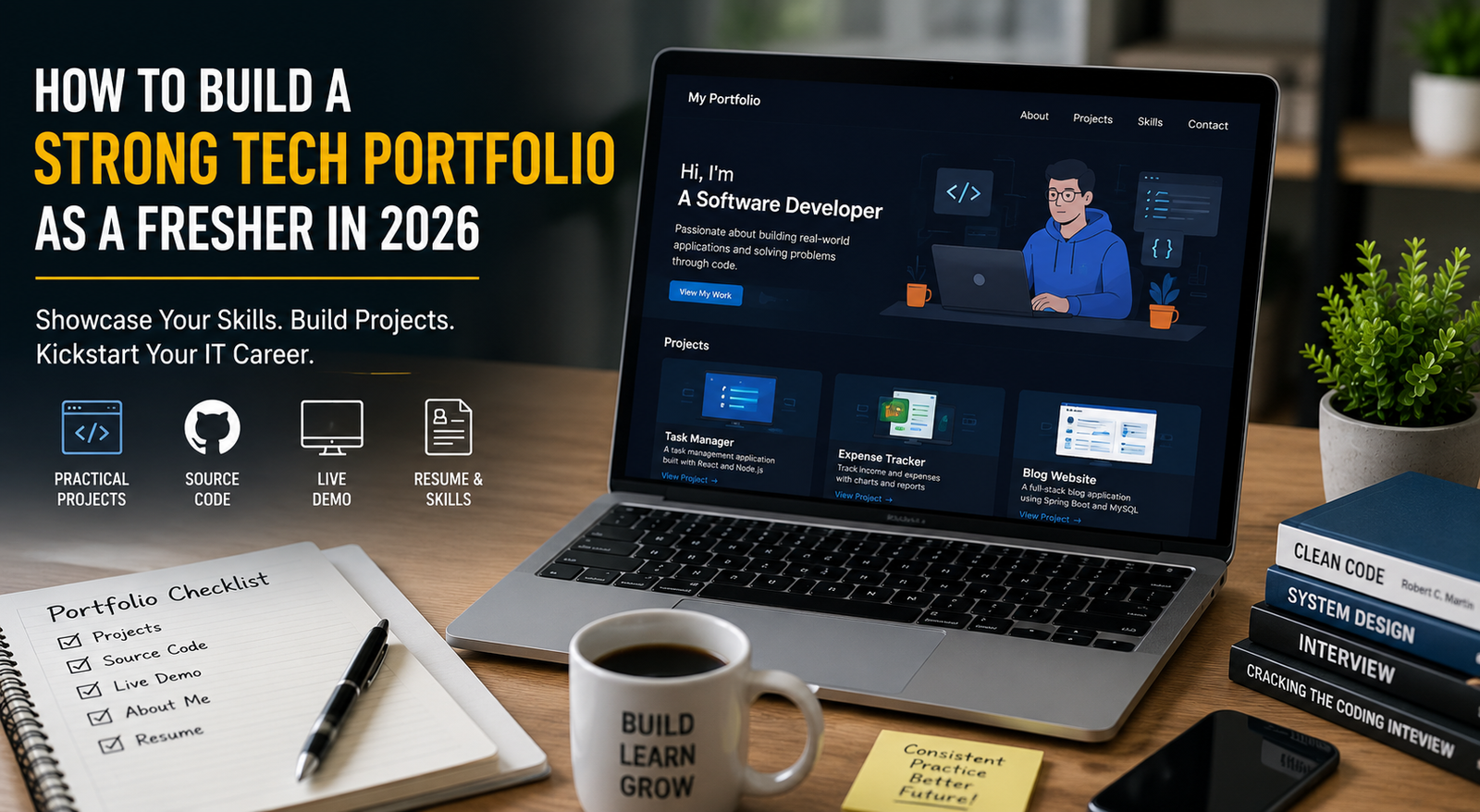
Having a degree, completing courses, and listing technical skills on your resume can help you start your job search, but freshers often face one important question: What can you actually build? This is where a strong tech portfolio for freshers can make a difference.
A portfolio gives you a practical way to demonstrate your programming knowledge, projects, problem-solving ability, and learning journey. Instead of simply telling employers that you know Java, Python, SQL, React, or another technology, you can show how you have used your skills to build something meaningful.
Why This Topic Matters
Many freshers spend months collecting certificates and learning technologies but do not spend enough time creating projects that demonstrate their knowledge.
For example, a resume may say:
Technical Skills: Java, SQL, HTML, CSS, JavaScript, Spring Boot
But a portfolio can show:
Project: Student Management System
Technology: Java, Spring Boot, SQL, HTML, CSS
Features: User authentication, student registration, database operations, search, update, and deletion.
The second approach gives someone a clearer understanding of what you can actually do.
Four reasons a portfolio is valuable for freshers
-
It demonstrates practical knowledge
-
It gives you projects to discuss during interviews
-
It helps organize your technical work
-
It shows how you apply what you learn
A portfolio does not need to contain ten projects. A few well-developed projects that you genuinely understand can be more useful than a large collection of unfinished work.
What You Need to Know
A fresher tech portfolio is more than a webpage containing your name and a list of technologies. It should provide evidence of your learning and practical work.
A useful portfolio can include:
-
Your professional introduction
-
Technical skills
-
Academic or personal projects
-
Project explanations
-
Source code where appropriate
-
Live project demonstrations where available
-
Certifications or relevant learning
-
Contact information
-
Resume
The most important section is usually your projects.
When someone opens a project, they should be able to understand what you built, why you built it, which technologies you used, and what your contribution was.
Your portfolio should answer one simple question: “What can this fresher actually build?”
Key Things to Focus On
1. Choose a Clear Career Direction
Your portfolio becomes stronger when it supports a specific career goal.
For example:
Java Developer:
Focus on Java, OOP, SQL, Spring Boot, REST APIs, database integration, and backend projects.
Full Stack Developer:
Show frontend development, backend APIs, databases, authentication, CRUD operations, and complete applications.
Data Analyst:
Focus on SQL, Excel, Python, data cleaning, analysis, visualization, and data-driven projects.
You do not need to demonstrate every technology available. Build depth around the role you want.
2. Build Projects That Solve Problems
Avoid creating projects only because they are common tutorial examples.
Instead, think about practical problems.
You could build:
-
Student Management System
-
Employee Management Application
-
Expense Tracker
-
Online Appointment System
-
Inventory Management System
-
Job Application Tracker
-
Learning Management System
-
Personal Finance Dashboard
The project does not have to be revolutionary.
What matters is whether you understand the problem, the technical implementation, and the decisions you made while developing it.

3. Explain Your Technical Decisions
Suppose you built an application using Spring Boot and SQL.
Do not only write:
Developed a web application using Spring Boot.
Explain what you implemented:
Developed REST APIs using Spring Boot and connected them with a SQL database to manage user and application records.
This gives you valuable discussion points for technical interviews.
4. Show Progress Instead of Perfection
Your first project may not be perfect.
That is completely normal.
You can improve it over time by adding:
-
Better validation
-
Error handling
-
Authentication
-
Search functionality
-
Pagination
-
Responsive design
-
Better database structure
-
API integration
-
Testing
A portfolio can show that you are capable of learning, improving, and solving problems independently.
A Practical Approach
Step 1: Decide Your Target Role
Before building your portfolio, decide what type of IT role you are preparing for.
Ask yourself:
Do I want to become a Java Developer?
Do I want to work as a Full Stack Developer?
Am I interested in frontend development?
Do I want to move toward data analytics?
Your answer will determine what projects and skills you should prioritize.
Step 2: Select Your Core Technology Stack
Choose a manageable technology stack instead of trying to learn everything simultaneously.
For example, a Java Full Stack fresher could focus on:
Java → SQL → HTML/CSS → JavaScript → Spring Boot → REST API → Database → Frontend framework
The exact stack can vary depending on your target role.
The goal is to become comfortable enough to build something without constantly depending on tutorials.
Step 3: Build Two or Three Strong Projects
Start with a manageable project and gradually increase the complexity.
Project 1: Basic CRUD application
Project 2: Database-driven application
Project 3: Full-stack application with authentication and APIs
For every project, document:
-
Problem statement
-
Technologies used
-
Features
-
Your contribution
-
Challenges faced
-
How you solved them
-
What you learned
Step 4: Make Your Projects Interview-Ready
Do not stop when the application works.
Ask yourself:
-
Can I explain the architecture?
-
Can I explain the database design?
-
Why did I choose this technology?
-
What happens when invalid data is entered?
-
How does authentication work?
-
How does the frontend communicate with the backend?
-
What problems did I face?
-
What would I improve in the next version?
These questions can turn a project into useful interview preparation.
Step 5: Connect Your Portfolio With Your Resume
Your resume and portfolio should tell the same story.
If your resume says you developed a Java application, your portfolio should contain accurate information about that project.
Avoid exaggerating your contribution.
If you worked on a project as part of a team, clearly explain what you personally worked on.
Consistency builds credibility.
Common Mistakes to Avoid
-
Adding copied tutorial projects without understanding them: Interviewers may ask basic questions about your implementation.
-
Creating too many unfinished projects: Focus on completing and improving a smaller number of projects.
-
Listing technologies you cannot explain: Your portfolio should reflect your genuine skills.
-
Ignoring project documentation: A good project becomes difficult to evaluate when there is no clear explanation.
-
Making the portfolio visually attractive but technically empty: Design can improve presentation, but practical work should remain the focus.
-
Using false claims: Never present a practice project as professional experience or claim responsibilities you did not perform.

Quick Checklist
Before sharing your tech portfolio, check:
-
My target IT role is clear.
-
I have included relevant technical skills.
-
I have at least two meaningful projects.
-
I can explain every project confidently.
-
Each project has a clear problem statement and feature description.
-
My technologies are listed accurately.
-
My resume and portfolio contain consistent information.
-
I have removed unfinished or irrelevant work.
-
My contact information is correct.
-
I have reviewed the portfolio for spelling, grammar, and presentation.
Frequently Asked Questions
Do freshers really need a tech portfolio?
A portfolio is not mandatory for every IT job, but it can be useful for demonstrating practical skills when you have limited professional experience. It gives you a place to present projects and provides concrete examples for technical discussions.
How many projects should a fresher have?
There is no fixed number. Two or three strong and relevant projects can be a good starting point. Focus on quality, understanding, and completeness rather than collecting a large number of projects.
What projects should IT freshers add to their portfolio?
Choose projects related to your target role. Java freshers can build database-driven applications and REST API projects, while full-stack candidates can build complete applications with frontend, backend, and database integration.
Can I include college projects in my portfolio?
Yes. College projects can be included if they are relevant and you clearly explain your contribution. If you worked as part of a team, be honest about which parts you personally handled.
Should a fresher portfolio include certifications?
Relevant certifications can be included, but they should support your technical profile rather than replace practical projects. Your portfolio should primarily demonstrate what you can apply.
Should I include projects that I built while learning?
Yes, provided you genuinely worked on them and understand the implementation. Be transparent about whether a project is academic, personal, or training-based.
What should I explain about each project?
Include the problem, technologies, major features, your contribution, important technical decisions, challenges, and what you learned. This makes the project easier to evaluate and gives you useful interview preparation.
Can I create a portfolio without professional experience?
Yes. Freshers can build portfolios using academic projects, personal projects, training projects, and practical learning work. Professional experience is not required to demonstrate your ability to build and learn.
Should my portfolio contain every technology I have learned?
No. Focus on technologies relevant to your target career path and projects. A focused portfolio is easier to understand than one containing an unrelated list of technologies.
Final Thoughts
Getting your first IT job as a fresher is not only about saying that you have learned a programming language. You need to gradually turn your knowledge into practical ability.
A strong tech portfolio can help you do exactly that. Start with one useful project, understand every part of it, improve it, document your work, and then build something more advanced.
You do not need to wait until you feel completely job-ready. Build while you learn. Learn from your projects. Improve them. Then use those projects to demonstrate your progress.
For freshers who want structured technical learning along with practical projects, aptitude preparation, communication development, interview preparation, and career guidance, VibrantMinds Technologies Pvt. Ltd. can support the learning journey from technical fundamentals to practical career preparation.
Your portfolio does not need to prove that you know everything. It needs to show that you can learn, build, solve problems, and explain the work you have done.