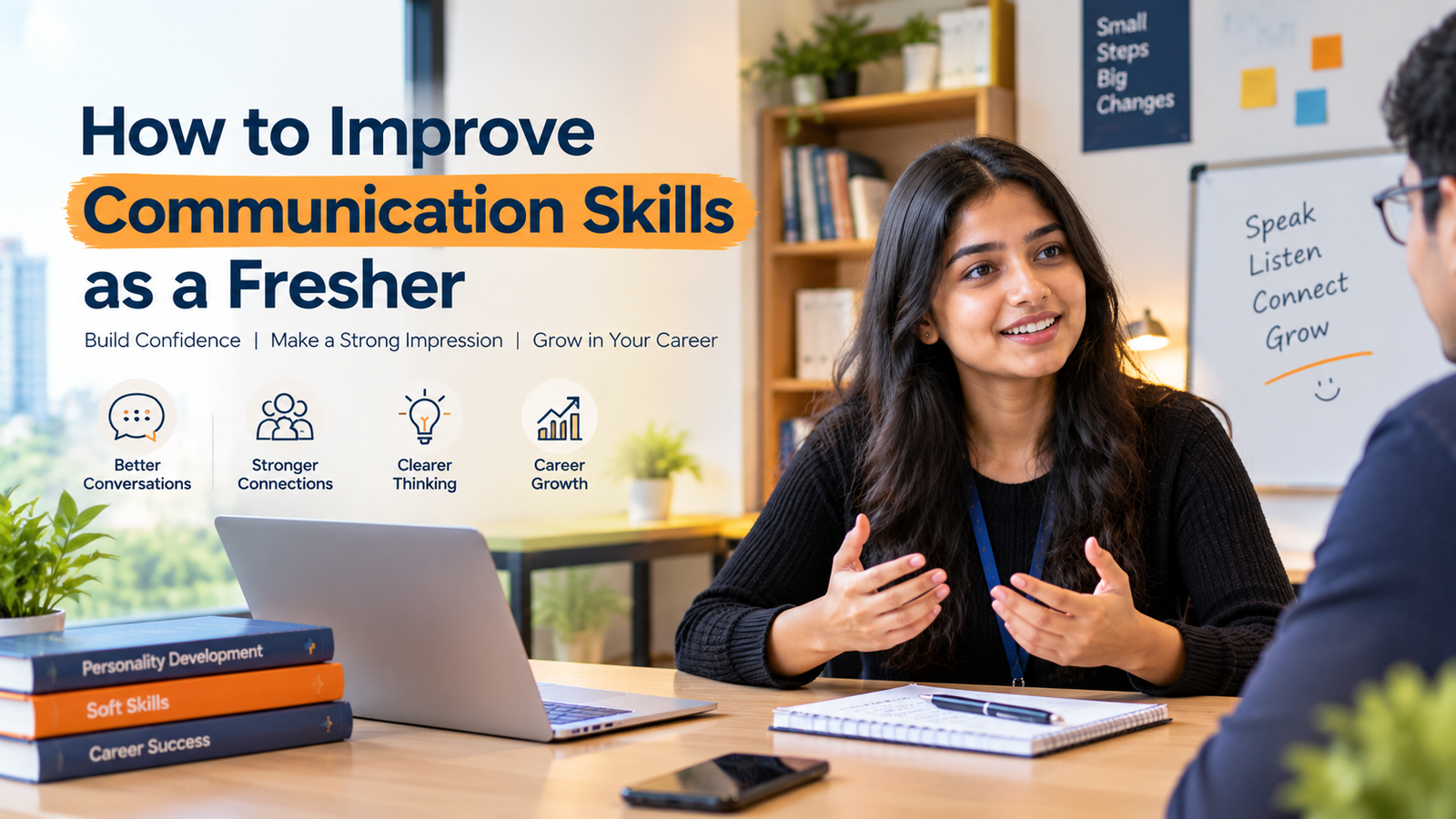
Many freshers know their subject well and still lose interviews because they cannot explain what they know. If you are searching for how to improve communication skills for freshers, or how to improve spoken English for interviews, this guide gives you a practical plan: the five skills that make up good communication, the common mistakes that Indian freshers make in English, a daily practice routine, a 30-day plan, ready-to-use phrases and templates, and tips for interviews, group discussions, phone calls and emails.
Good communication is not about fancy words or a foreign accent. It is about being clear, correct and confident enough that the listener understands you easily. Anyone can improve it with regular practice, and you do not need expensive tools to start. The guidance below is general and practical, and results depend on how consistently you practise.
|
Explore VibrantMinds VibrantMinds Technologies is a Pune-based IT training and recruitment company. Learn more about its courses and placement process, or visit the candidate portal. |
Why Communication Skills Matter for IT Freshers
In IT, you are not only judged on code or test cases. You explain your project in the interview, describe a bug to a developer, discuss requirements with a team, write emails to clients and give updates in meetings. Technical skill gets you shortlisted, but communication often decides whether you are selected and how fast you grow afterwards.
Interviewers also use communication as a signal. A candidate who answers clearly and structures ideas well appears organised and ready to learn, even if the answer is not perfect. A candidate who knows the answer but cannot express it often looks unprepared. The good news is that this is a skill, not a talent, and skills improve with practice.
The Five Pillars of Good Communication
Instead of trying to "improve English" in a vague way, work on these five areas one at a time:

• Clarity: one idea per sentence, with the main point first.
• Vocabulary: a working set of words you can use easily, not a list of difficult words you cannot say naturally.
• Grammar: correct tenses and sentence structure, especially for common patterns.
• Pronunciation: clear sounds and stress, so people understand you the first time.
• Confidence: a steady voice, a calm pace and relaxed body language.
Notice that confidence comes last. It usually grows as the first four improve and as you practise in real situations.
Common English Mistakes Freshers Make (and How to Fix Them)
Some mistakes are so common in spoken English that people repeat them without noticing. Fixing even a handful makes your speech sound noticeably more professional. Read the pairs below aloud until the correct version feels natural:
WEAK -> BETTER
Myself Rahul. -> I am Rahul. / My name is Rahul.
I am having one project. -> I have one project.
I am agree with you. -> I agree with you.
Let us discuss about it. -> Let us discuss it.
I can able to do it. -> I can do it. / I am able to do it.
Please revert back. -> Please reply. / Please revert.
This is more better. -> This is better.
He don't know the answer. -> He doesn't know the answer.
Explain me the process. -> Explain the process to me.
I have completed B.E. in 2025. -> I completed my B.E. in 2025.
I cannot cope up with it. -> I cannot cope with it.
The rule behind several of these: verbs of state such as have, know, agree and want are rarely used in the "-ing" form, and a specific past time such as "in 2025" goes with the simple past tense, not the present perfect.
How to Speak Clearly: Simple Sentence Habits
• Start with the answer. "I chose Java because..." is clearer than a long introduction.
• Use short sentences. If a sentence needs a breath in the middle, split it into two.
• Use the structure point, reason, example. It works for almost any question.
• Pause instead of saying "umm." A silent second sounds more confident than a filler.
• Replace vague words with specific ones. Instead of "some things," name the two things.

How to Improve Spoken English: A Daily 30-Minute Routine
Short, regular practice works better than one long session a week. Use this routine and adjust the minutes to your schedule:
1. 5 minutes: vocabulary. Learn five useful words or phrases and use each in a sentence you say aloud.
2. 10 minutes: speak aloud. Describe your day, explain a technical concept or retell something you read, as if teaching a friend.
3. 5 minutes: listen and repeat. Play a short clear talk or interview, pause after each sentence and repeat it, copying the rhythm and tone. This is called shadowing.
4. 5 minutes: write. Write five lines about what you learned today. Correct them or ask someone to check.
5. 5 minutes: record and review. Record yourself answering one interview question, listen back and note one thing to improve.
Recording yourself feels awkward at first, but it is one of the fastest ways to improve. You will hear filler words, rushed sentences and mispronounced words that you cannot notice while speaking.
Pronunciation Tips for IT Words
You do not need a foreign accent, but clear pronunciation of common technical words helps interviewers understand you immediately. Use a good dictionary with audio to check any word you are unsure about. Here are some common IT words with hints:
WORD -> HOW IT IS COMMONLY SAID
cache -> "cash"
queue -> "kyoo"
Linux -> "LIN-ux"
Boolean -> "BOO-lee-un"
pseudo -> "SOO-doh" (as in pseudocode)
integer -> "IN-tuh-jer"
array -> "uh-RAY"
SQL -> "S-Q-L" (many people also say "sequel")
Useful Phrases for Interviews and Meetings
Starting and Buying Time
• "Thank you for asking. Let me think for a moment."
• "That is a good question. Here is how I would approach it."
Clarifying a Question
• "Could you please repeat the question?"
• "Just to confirm, are you asking about [topic]?"
When You Do Not Know the Answer
• "I am not sure about that, but here is what I do know..."
• "I have not worked on that yet. I would find out by..."
Disagreeing Politely
• "I see your point. I would also like to add..."
• "That is one way. Another option could be..."
Closing
• "Thank you for your time. I look forward to hearing from you."
Group Discussion Tips for Freshers
A group discussion tests how you listen, think and speak in a group. You do not need to speak the most; you need to speak well.
• Listen first. Notice the main points before you add yours.
• Start or enter with a clear point. Use a short opening such as "I would like to add..." and keep it to a few sentences.
• Support your point with an example or fact you are sure of.
• Respect others. Do not interrupt or argue loudly. Build on a point instead.
• Summarise if you can. A calm one-line summary at the end shows structure.
Phone and Video Interview Tips
• Find a quiet place and check your internet, microphone and camera before the call.
• Speak slightly slower than usual, because audio can lose clarity.
• Smile at the start. It changes the tone of your voice, even on a phone call.
• Keep your resume and notes in front of you, but do not read from them.
• If the connection breaks, calmly say, "I'm sorry, the connection dropped. Could you please repeat that?"
How to Write Professional Emails
Emails are part of your first impression with recruiters. Keep them short, polite and specific. A clear subject line, a greeting, the point in the first line and a polite close are enough.
EMAIL TO A RECRUITER
Subject: Interview Schedule Confirmation - [Your Name]
Dear [Recruiter's name],
Thank you for shortlisting me for the [Role] position. I confirm that
I will attend the interview on [date] at [time]. Please let me know if
I should bring any additional documents.
Regards,
[Your Name] | [Phone]
Avoid chat-style language in professional emails, such as "pls," "u" or heavy use of emojis, and always reread before you send.
A 30-Day Plan to Improve Communication Skills
Use this plan along with the daily routine. It is indicative, so adjust it to your pace.

Listening Skills: The Half of Communication Freshers Ignore
Good communicators listen first. In an interview, many freshers start answering after hearing only the first few words of the question and end up answering a different question. Listen to the whole question, wait a second, and then answer. If the question is long, note the key words in your mind, such as "challenge" or "team," so your answer matches what was asked.
• Do not interrupt, even if you think you know the question.
• Repeat key words from the question in your answer, which shows you understood it.
• Ask politely for clarification if a question is unclear, instead of guessing.
• In group settings, listen to others' points so you can build on them instead of repeating them.
Body Language: What Your Posture and Face Say
Words are only part of the message. Interviewers also notice how you sit, where you look and how you react. Small habits help: sit upright with your back supported, keep your hands relaxed on the table or lap, look at the interviewer while speaking and nod slightly while listening. A calm smile at the start and end of the conversation shows confidence and warmth. Avoid crossing your arms tightly, shaking your leg or looking at the floor for long, since these can signal nervousness or disinterest. For video interviews, place the camera at eye level and look at the lens when you speak.
How to Structure Any Interview Answer: A Worked Example
The point, reason, example structure keeps your answer clear even when you are nervous. Here is a fictional example for the question "Why did you choose Java?"
• Point: "I chose Java because it is widely used for building business applications."
• Reason: "Its strong structure also helped me understand object-oriented programming properly."
• Example: "I used these ideas to build a student result system with a MySQL database, which taught me how a real application is organised."
That is three short sentences, about twenty seconds long, with a clear beginning and end. Replace the details with your own true experience and you have a reliable pattern for almost any question.
How to Run a Mock Interview With a Friend
Real practice with another person is one of the most effective ways to improve, and it costs nothing. Here is a simple routine:
• Ask your friend to act as the interviewer and prepare five questions from the job description, including one about a project and one about a weakness.
• Dress and sit as you would in a real interview, and treat the time seriously.
• Answer without stopping to restart. Real interviews do not allow do-overs.
• Ask your friend to note three things: what was clear, what was confusing and what filler words you used.
• Repeat the same questions a few days later and compare your answers.
Even two or three rounds of this make your answers noticeably smoother, because you discover problems in a safe setting.
Mistakes That Slow Down Your Progress
1. Waiting until your English is perfect to start speaking. You improve by speaking, not by waiting.
2. Memorising long answers word for word. They sound robotic and break under follow-up questions.
3. Using difficult words to sound smart. Simple and correct is always better.
4. Never recording yourself. You cannot fix what you cannot hear.
5. Practising only alone. Speak with friends, mentors or mock interviewers to get feedback.
6. Comparing yourself with fluent speakers. Compare yourself with last month's version of you.
7. Giving up after a bad interview. Write down what went wrong, fix one thing and try again.
About VibrantMinds Technologies
VibrantMinds Technologies Pvt. Ltd. is a Pune-based IT training and recruitment company. It operates as a talent ecosystem that connects candidates, colleges and companies, with 1900+ partner colleges and 600+ hiring companies in its network.
Visit vibrantminds.in to learn about the company, or open the candidate portal at candidates.vibrantminds.in.
These are the VibrantMinds courses:
|
Course |
Duration |
Key topics |
|
Full Stack Java Development |
4–6 months |
Core Java, OOP, SQL and JDBC, web fundamentals, backend frameworks, front-end basics, projects |
|
Software Testing (Manual + Automation) |
2–5 months |
Testing fundamentals, test cases, bug reporting, SDLC and STLC, automation basics, interview preparation |
|
Core Java |
1–2 months |
Syntax, OOP, strings, collections, exception handling, practice programs |
|
Python & Data Science |
2–4 months |
Python basics, data handling, analysis libraries, visualisation, introduction to machine learning |
How VibrantMinds Helps You Speak and Interview With Confidence
Communication improves fastest when you have real things to talk about and real practice to talk them through. Training in Core Java, Full Stack Java Development, Software Testing or Python & Data Science gives you projects, test cases and analysis work to explain, which is the content of every strong interview answer. The Software Testing course also lists interview preparation among its topics. Ask the team how presentations, mock interviews and communication practice work in the batch you are considering.
The VibrantMinds 6-step placement pipeline then connects your preparation to real openings:
1. Requirement Mapping: understanding what hiring companies need, so your preparation matches real requirements.
2. Candidate Sourcing: identifying candidates who fit those openings.
3. Screening & Assessment: checking skills and readiness, so gaps surface before a real interview.
4. Drive Coordination: organising recruitment drives with hiring companies.
5. Interview Support: preparing candidates for interview rounds, where clear communication matters most.
6. Onboarding Follow-up: staying in touch after selection to support the joining process.
|
VibrantMinds tip Want structured interview practice behind your communication skills? Talk to the team and ask which assessments, mock interviews and interview support come with the batch you are considering. |
Real Outcomes: What Past Students Say
Feedback shared by past students mentions placements with companies such as Aress Software and Education Technologies, Saama Technologies and Three M Software. To be clear and fair: outcomes vary from person to person, depending on skills, effort, attendance, interview performance and company requirements. Nothing here is a guarantee of a job, so please confirm details directly with the VibrantMinds team before you decide.
Connect With VibrantMinds Technologies
Address: Viva Academy Building, Warje, Pune, Maharashtra 411052
Phone: +91 95035 79517
Email: support@vibrantmindstech.com
Website: https://vibrantminds.in/
Candidate portal: https://candidates.vibrantminds.in/
Join the Job-Update WhatsApp Groups
Group 1: https://chat.whatsapp.com/CUCS1derlmTFee2c9dyUHd
Group 2: https://chat.whatsapp.com/FvMf1fGYQYnHppQ8AwFX40
Group 3: https://chat.whatsapp.com/I7RNnGMkb2L8S8HibdyWpQ
|
Caution: never pay anyone to apply for a job or to get shortlisted. If someone asks for money in exchange for a job opportunity, stop and verify directly with the company or the VibrantMinds team. |
Frequently Asked Questions About Communication Skills
How long does it take to improve communication skills?
It depends on your starting level and how consistently you practise. Many people notice a difference in a few weeks of daily practice, and deeper improvement comes over months. Consistency matters more than intensity.
Do I need a perfect accent to get an IT job?
No. Interviewers care much more about clarity, correctness and confidence than about accent. Focus on speaking clearly and at a steady pace.
Should I learn difficult English words?
Not for their own sake. Words you cannot use naturally make you sound unnatural. Build a vocabulary of useful, everyday professional words you can say with ease.
How can I practise if I have nobody to speak English with?
Talk to yourself aloud, explain topics as if teaching someone, record yourself, shadow short audio clips and practise answers in front of a mirror. Mock interviews with friends or mentors add real feedback when possible.
How do I stop being nervous in interviews?
Prepare answers to common questions, practise out loud, breathe slowly before you answer and remember that a short pause is acceptable. Nervousness is common, and experience reduces it.
Is it fine to mix Hindi or Marathi words in an interview?
In an English interview, try to answer fully in English, and ask politely if you may use another language when you struggle to express something. Follow the interviewer's lead on language.
What if I forget a word during an answer?
Pause, use a simpler word or describe what you mean in other words, and carry on. Interviewers mostly care about the idea, not the exact word.
Are there free ways to improve spoken English?
Yes. Free audio talks, dictionary apps with pronunciation audio, recording yourself on your phone and speaking daily with friends are all free methods that work with regular practice.
Final Thoughts: Start Speaking Today
Communication improves the same way any skill does: through regular, imperfect practice. Start with ten minutes today. Say your self-introduction aloud, record it, fix one mistake and repeat tomorrow. In a month, you will sound clearer and feel calmer, and in an interview that difference often matters as much as the technical answer.
If you would like structured preparation, with projects to talk about and interview practice, the VibrantMinds team is happy to help you plan your next step.