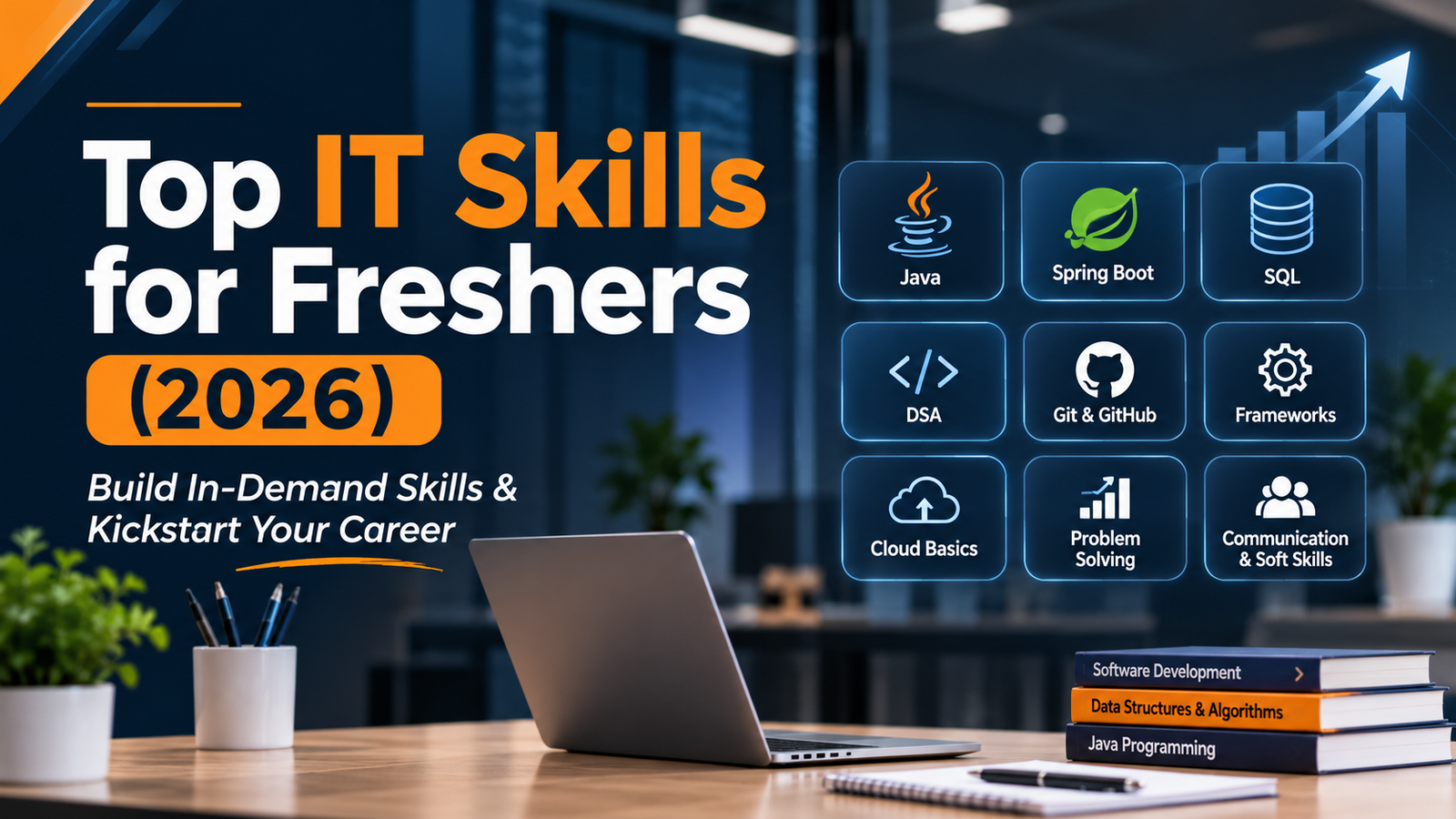

The competition is also tougher than before. Recruiters no longer stop at "What is polymorphism?". A modern Java technical interview checks whether you can write clean code on the spot, explain how the Collections Framework works internally, design a small REST API with Spring Boot, write a SQL query, and talk confidently about a project you built yourself. If you only memorise definitions, you will struggle after the first follow-up question.
This guide is written for freshers who want a clear, practical path. You will find the interview rounds explained, a topic-wise priority map, Java interview questions for freshers with answers, real code examples, project ideas that impress interviewers, HR preparation, a 12-week preparation plan, and a section on how VibrantMinds Technologies in Pune can train you and support your placement journey.
|
What you will learn in this guide How a Java fresher hiring process works round by round, with a funnel chart. Which topics carry the most weight, shown with a ratio chart and a priority table. 50+ Java, Spring Boot, SQL and DSA interview questions with short, interview-ready answers. Code you can type and explain in an interview: OOP, collections, streams, threads, REST and SQL. Five projects for your resume, a weekly roadmap, a preparation cycle and a readiness curve. |
Java Fresher Job Market in 2026: What Recruiters Actually Want
Before you start studying, understand what the person on the other side of the table is looking for. A hiring manager interviewing a fresher knows you have little work experience. They are not expecting expert-level system design. They are testing four things: strong fundamentals, problem-solving ability, ability to learn quickly, and communication.
|
What recruiters check |
How they test it |
What a strong fresher shows |
|
Core Java fundamentals |
Direct questions, output-prediction snippets |
Clear OOP concepts, correct use of String, collections and exceptions |
|
Problem solving |
Coding on paper, whiteboard or online IDE |
Logical approach, edge cases handled, readable code |
|
Practical exposure |
Project discussion, Spring Boot and SQL questions |
A working project on GitHub that you can explain end to end |
|
Learning attitude |
Questions on latest Java versions, tools, Git |
Awareness of Java 17/21 features, Maven, Git, REST and testing basics |
|
Communication |
HR round, explaining your code aloud |
Structured answers, honest admission when you do not know something |
Notice that only one of the five rows is pure theory. This is why preparing only from a list of interview questions rarely works. You must combine concepts + code + projects + communication.
Java Interview Process for Freshers: Rounds Explained
Most IT services companies, product startups and campus drives follow a similar structure. The names change, but the filtering pattern is almost always the same. The funnel below shows how the candidate pool narrows at each stage.

Chart 1: Typical hiring funnel for a Java fresher (illustrative).
|
Round |
What is tested |
Typical format |
How to prepare |
|
1. Aptitude / online test |
Quantitative, logical reasoning, verbal ability, basic coding MCQs |
30 to 90 minutes, timed, online |
Daily aptitude practice, previous papers, time management |
|
2. Technical round 1 |
Core Java, OOP, collections, coding problems |
30 to 45 minutes, face to face or video call |
Revise fundamentals, solve 3 to 5 problems daily |
|
3. Technical round 2 |
Project deep dive, Spring Boot, REST, SQL, DSA |
45 to 60 minutes |
Know every line of your project, prepare database design |
|
4. Managerial / HR |
Attitude, communication, relocation, salary, goals |
15 to 30 minutes |
Prepare self-introduction, strengths, weaknesses, why this company |
|
Pro tip Many freshers prepare for the technical round and then lose the offer in the HR round. Give HR preparation at least 10% of your total time. The time split chart later in this guide shows exactly where it fits. |
Java Interview Topics Map: What to Study and in What Order
Java is a huge ecosystem. If you try to learn everything, you will learn nothing well. The chart below shows the approximate share of questions asked in a typical fresher technical round. Use it to decide where your hours go.

Chart 2: Share of questions by topic in a typical Java fresher technical round (indicative).
|
Topic |
Must-know subtopics |
Priority |
|
Core Java & OOP |
JVM/JDK/JRE, data types, String pool, static, final, inheritance, polymorphism, abstraction, encapsulation, interfaces |
Very high |
|
Collections & Generics |
List, Set, Map, Queue, HashMap internals, Comparable vs Comparator, fail-fast iterators |
Very high |
|
DSA & Coding |
Arrays, strings, recursion, sorting, searching, linked list, stack, queue, hashing, basic trees |
Very high |
|
SQL & JDBC |
Joins, GROUP BY, HAVING, subqueries, indexes, normalisation, transactions, JDBC steps |
High |
|
Spring Boot & REST |
IoC, DI, annotations, controller-service-repository, JPA, exception handling, REST principles |
High |
|
Java 8+ Features |
Lambda, functional interfaces, Stream API, Optional, records, text blocks, switch expressions |
High |
|
Exceptions & Multithreading |
Checked vs unchecked, try-with-resources, thread lifecycle, synchronized, volatile, ExecutorService |
Medium |
|
Tools & Basics |
Git, Maven, Postman, basic Linux commands, unit testing with JUnit |
Medium |
Core Java Interview Questions for Freshers with Answers
These are the questions that appear again and again in Java fresher interviews. Do not memorise the answers word for word. Understand the idea, then explain it in your own sentences with a small example.
A. Java basics and JVM
1. What is the difference between JDK, JRE and JVM?
The JVM executes bytecode and provides memory management and garbage collection. The JRE is the JVM plus the standard libraries needed to run programs. The JDK is the JRE plus development tools such as the compiler (javac), debugger and jar tool. A developer installs the JDK; a user who only runs Java apps needs the runtime.
2. Why is Java called platform independent?
The compiler converts source code into bytecode, not machine code. Any operating system with a JVM can run that same bytecode, so the principle is "write once, run anywhere". The JVM itself is platform dependent, but your program is not.
3. Explain the Java memory areas: heap and stack.
The stack stores method calls, local variables and references; each thread has its own stack. The heap stores all objects and is shared by threads. Garbage collection reclaims heap objects that are no longer reachable. Modern JVMs use the G1 garbage collector by default.
4. What is the difference between == and equals()?
For objects, == compares references (are both variables pointing to the same object?), while equals() compares logical content if the class overrides it. String, Integer and other wrapper classes override equals(). If you override equals(), you must also override hashCode() so equal objects produce the same hash; otherwise HashMap and HashSet misbehave.
5. What is the String pool? Why is String immutable?
String literals are stored in a special area called the String pool so identical literals share one object and save memory. Strings are immutable for security (class names, file paths, URLs), thread safety, safe use as HashMap keys, and to make pooling possible.
|
Feature |
String |
StringBuilder |
StringBuffer |
|
Mutability |
Immutable |
Mutable |
Mutable |
|
Thread safety |
Safe (immutable) |
Not thread safe |
Thread safe (synchronized) |
|
Speed |
Slow for repeated changes |
Fastest |
Slower than StringBuilder |
|
Use when |
Constant text, keys |
Single-thread string building |
Shared string building (rare today) |
6. What is the Integer cache trap?
Integer values from -128 to 127 are cached, so Integer a = 100, b = 100; a == b is true, but for 1000 it is false because separate objects are created. Always compare wrapper objects with equals().
B. OOP concepts
7. Explain the four pillars of OOP with real-life examples.
Encapsulation wraps data and methods and hides internals using private fields and getters/setters (a bank account hides its balance). Inheritance lets a class reuse another's behaviour (Car extends Vehicle). Polymorphism means one interface, many forms: method overloading at compile time and overriding at runtime. Abstraction exposes only essentials using abstract classes and interfaces (you drive a car without knowing engine internals).
8. Difference between method overloading and overriding?
Overloading means the same method name with different parameters in the same class, resolved at compile time. Overriding means a subclass provides its own implementation of a parent method with the same signature, resolved at runtime. Return type alone cannot overload a method, and an overriding method cannot reduce visibility.
|
Point |
Abstract class |
Interface |
|
Methods |
Abstract and concrete |
Abstract, default, static and private methods (Java 8/9+) |
|
Variables |
Any type of variable |
public static final constants only |
|
Inheritance |
A class extends only one |
A class can implement many |
|
Constructor |
Allowed |
Not allowed |
|
Best for |
Shared state and common base behaviour |
Defining a contract / capability |
9. What are the SOLID principles?
Single Responsibility: a class has one reason to change. Open/Closed: open for extension, closed for modification. Liskov Substitution: a subclass should be usable wherever the parent is expected. Interface Segregation: many small interfaces beat one big one. Dependency Inversion: depend on abstractions, not concrete classes. Spring's dependency injection is a practical example of the last one.
10. What is the use of the static keyword? Difference between this and super?
static members belong to the class, not to any object, so they are loaded once and shared. this refers to the current object; super refers to the parent class (to call its constructor or overridden methods).
C. Exceptions
11. Checked vs unchecked exceptions?
Checked exceptions (IOException, SQLException) are verified by the compiler; you must handle or declare them. Unchecked exceptions (NullPointerException, ArrayIndexOutOfBoundsException) extend RuntimeException and usually indicate programming errors.
12. final vs finally vs finalize?
final makes a variable constant, a method non-overridable or a class non-inheritable. finally is a block that runs after try/catch, mostly for cleanup. finalize() was an object cleanup hook that is deprecated for removal; use try-with-resources instead.
|
// Custom exception and try-with-resources public class InvalidAgeException extends RuntimeException { public InvalidAgeException(String message) { super(message); } }
static void register(int age) { if (age < 18) throw new InvalidAgeException("Minimum age is 18"); System.out.println("Registered"); }
// try-with-resources closes the reader automatically try (BufferedReader br = new BufferedReader(new FileReader("data.txt"))) { System.out.println(br.readLine()); } catch (IOException e) { System.err.println("File error: " + e.getMessage()); } |
Java Collections Framework Interview Questions: The Most Important Topic
If you master only one area for a Java developer interview, make it collections. Interviewers love this topic because it reveals how deeply you understand data structures, time complexity and real-world design choices.
13. How does HashMap work internally?
HashMap stores entries in an array of buckets. When you call put(key, value), Java computes hashCode() of the key, spreads the bits, and derives a bucket index. If the bucket is empty the entry is stored; if another key lands there (a collision) entries are chained in a linked list. When a single bucket grows beyond 8 entries and the table has at least 64 buckets, the list is converted into a balanced tree so lookups stay O(log n).
The default load factor is 0.75: when the map is 75% full the table doubles in size and entries are redistributed (rehashing). get() uses hashCode to find the bucket and equals() to find the exact key. Average time for get and put is O(1).
|
Collection |
Order |
Duplicates |
Null allowed |
Get / Add complexity |
Use when |
|
ArrayList |
Insertion |
Yes |
Yes |
get O(1), add end O(1) amortised, insert middle O(n) |
Fast random access, read-heavy lists |
|
LinkedList |
Insertion |
Yes |
Yes |
get O(n), add/remove at ends O(1) |
Frequent insert/remove at the ends (queue, deque) |
|
HashSet |
None |
No |
One null |
add/contains O(1) avg |
Unique values, fast lookup |
|
LinkedHashSet |
Insertion |
No |
One null |
O(1) avg |
Unique values with insertion order |
|
TreeSet |
Sorted |
No |
No |
O(log n) |
Sorted unique values |
|
HashMap |
None |
Unique keys |
One null key |
O(1) avg |
General key-value storage |
|
LinkedHashMap |
Insertion / access |
Unique keys |
One null key |
O(1) avg |
Cache (LRU) and ordered maps |
|
TreeMap |
Sorted by key |
Unique keys |
No null key |
O(log n) |
Sorted key-value data, range queries |
14. HashMap vs Hashtable vs ConcurrentHashMap?
HashMap is not thread safe and allows one null key. Hashtable is legacy, synchronises every method and allows no nulls, so it is slow. ConcurrentHashMap is built for concurrency: it locks at a much finer level, allows concurrent reads and writes and does not allow null keys or values. In modern code prefer ConcurrentHashMap when threads share a map.
15. What is the difference between fail-fast and fail-safe iterators?
Fail-fast iterators (ArrayList, HashMap) throw ConcurrentModificationException if the collection is structurally modified during iteration. Fail-safe iterators (CopyOnWriteArrayList, ConcurrentHashMap) work on a copy or a weakly consistent view, so they do not throw.
16. Comparable vs Comparator?
Comparable defines the natural order inside the class itself via compareTo(). Comparator defines an external, custom order via compare(), so you can sort the same class in many ways (by name, by salary, by joining date).
|
// Sort by marks (descending), then by name List<Student> list = new ArrayList<>(students); list.sort(Comparator.comparing(Student::getMarks).reversed() .thenComparing(Student::getName)); |
Java Multithreading Interview Questions for Freshers
Freshers are rarely asked to build complex concurrent systems, but you must be comfortable with the basics. Interviewers want to see that you know why concurrency bugs happen.
17. What is the difference between a process and a thread? How do you create a thread?
A process is an independent program with its own memory; a thread is a lightweight unit of execution inside a process that shares memory with other threads. You can create a thread by extending Thread, by implementing Runnable (preferred), or by submitting tasks to an ExecutorService.
18. What do synchronized and volatile do?
synchronized allows only one thread at a time to run a block or method and also guarantees visibility. volatile guarantees that reads and writes of a variable go to main memory so all threads see the latest value, but it does not make compound actions like count++ atomic. For atomic counters use AtomicInteger.
19. What is a deadlock and how can you avoid it?
A deadlock happens when two or more threads wait forever for locks held by each other. Avoid it by acquiring locks in a consistent order, holding locks for the shortest time, using timeouts with tryLock(), and preferring higher-level utilities from java.util.concurrent.
20. What are virtual threads?
Virtual threads, finalised in Java 21, are lightweight threads managed by the JVM rather than the operating system. They let you handle thousands of blocking tasks, such as web requests, with simple thread-per-request code. Mentioning them shows the interviewer you follow modern Java.
|
// ExecutorService and virtual thread ExecutorService pool = Executors.newFixedThreadPool(4); Future<Integer> result = pool.submit(() -> 21 * 2); System.out.println(result.get()); // 42 (inside a method that throws Exception) pool.shutdown();
// Java 21 virtual thread Thread.ofVirtual().start(() -> System.out.println("Hello from a virtual thread")); |
Java 8, 17, 21 and Modern Java Features Interviewers Ask About
Even for a fresher role, interviewers expect you to know Java 8 features (lambdas and streams) and to have heard of later improvements. Java 17 and Java 21 are Long-Term Support (LTS) releases that many companies use in production; check the current LTS release before your interview so you can speak about it with confidence.
|
Feature |
Introduced in |
One-line explanation |
|
Lambda expressions |
Java 8 |
Short anonymous functions: (a, b) -> a + b |
|
Functional interfaces |
Java 8 |
Interface with a single abstract method, e.g. Runnable, Predicate, Function |
|
Stream API |
Java 8 |
Declarative pipelines: filter, map, reduce, collect |
|
Optional |
Java 8 |
Container that avoids null checks and NullPointerException |
|
var (local variable type inference) |
Java 10 |
Compiler infers the type: var list = new ArrayList<String>(); |
|
Text blocks |
Java 15 |
Multi-line strings using triple quotes |
|
Records |
Java 16 |
Compact immutable data classes: record Point(int x, int y) {} |
|
Sealed classes |
Java 17 |
Restrict which classes can extend a type |
|
Pattern matching, switch expressions |
Java 14 to 21 |
Cleaner type checks and expression-style switch |
|
Virtual threads |
Java 21 |
Lightweight JVM-managed threads for high concurrency |
21. map() vs flatMap() in streams?
map() transforms each element into exactly one new element. flatMap() transforms each element into a stream and flattens all those streams into one, for example turning a list of lists into a single list.
|
// Stream API example commonly asked in interviews record Employee(String name, String dept, double salary) {}
// Average salary per department for employees earning above 30000 Map<String, Double> avg = employees.stream() .filter(e -> e.salary() > 30000) .collect(Collectors.groupingBy(Employee::dept, Collectors.averagingDouble(Employee::salary)));
// Names of the top 3 highest paid employees List<String> top3 = employees.stream() .sorted(Comparator.comparingDouble(Employee::salary).reversed()) .limit(3) .map(Employee::name) .toList(); |
Java Coding Interview Programs Every Fresher Should Practise
Interviewers often ask you to write a small program and then explain it line by line. Practise typing these without an IDE's autocomplete. Always mention the time and space complexity at the end.
|
// Strings and basic logic // 1. Reverse a string and check palindrome static boolean isPalindrome(String s) { String clean = s.replaceAll("[^A-Za-z0-9]", "").toLowerCase(); return clean.equals(new StringBuilder(clean).reverse().toString()); }
// 2. First non-repeating character (O(n) time) static char firstUnique(String s) { Map<Character, Integer> freq = new LinkedHashMap<>(); for (char c : s.toCharArray()) freq.merge(c, 1, Integer::sum); for (var e : freq.entrySet()) if (e.getValue() == 1) return e.getKey(); return '\0'; }
// 3. Fibonacci (iterative, O(n) time, O(1) space) static long fib(int n) { long a = 0, b = 1; for (int i = 0; i < n; i++) { long t = a + b; a = b; b = t; } return a; } |
|
// Design questions: immutable class and Singleton // Immutable class: final class, final fields, no setters, defensive copy public final class Student { private final int id; private final String name; private final List<String> skills;
public Student(int id, String name, List<String> skills) { this.id = id; this.name = name; this.skills = List.copyOf(skills); // defensive copy } public int getId() { return id; } public String getName() { return name; } public List<String> getSkills() { return skills; } }
// Thread-safe Singleton using the holder idiom public class AppConfig { private AppConfig() {} private static class Holder { static final AppConfig INSTANCE = new AppConfig(); } public static AppConfig getInstance() { return Holder.INSTANCE; } } |
|
Interview habit that sets you apart Before writing code, say your approach in one or two sentences, mention edge cases (empty input, null, duplicates), then code. Finish by walking through a sample input and stating the complexity. This structure alone makes an average solution sound professional. |
Spring Boot Interview Questions for Freshers (REST API, JPA, Dependency Injection)
Many companies hiring Java freshers use Spring Boot, so basic questions on it are now common even for entry-level roles. You are not expected to be an expert, but you should be able to build and explain a simple CRUD application.
22. What is Spring Boot and how is it different from the Spring Framework?
Spring is a large framework for building Java applications around dependency injection. Spring Boot sits on top of it and removes configuration effort through auto-configuration, starter dependencies, an embedded server (Tomcat) and production-ready features such as Actuator. You can run a Boot app as a simple jar with java -jar.
23. What are IoC and Dependency Injection?
Inversion of Control means the framework, not your code, creates and manages objects. Dependency Injection is how it hands dependencies to a class, ideally through the constructor. This keeps classes loosely coupled and easy to test.
24. What does @SpringBootApplication do?
It combines @Configuration, @EnableAutoConfiguration and @ComponentScan, so Spring configures itself from the classpath and scans your packages for beans.
25. @Component vs @Service vs @Repository vs @Controller?
All four register a bean. @Component is generic; @Service marks business logic; @Repository marks the data layer and translates persistence exceptions; @Controller / @RestController handle web requests. Using the right one improves readability and tooling.
26. What is the difference between @Controller and @RestController?
@RestController is @Controller plus @ResponseBody, so every method returns data (usually JSON) directly in the HTTP response body instead of a view name.
27. What are the main REST principles and HTTP methods?
REST uses stateless communication, resources identified by URLs and standard HTTP methods: GET to read, POST to create, PUT to replace, PATCH to partially update and DELETE to remove. Know common status codes: 200 OK, 201 Created, 204 No Content, 400 Bad Request, 401 Unauthorized, 403 Forbidden, 404 Not Found, 500 Internal Server Error.
28. JPA vs Hibernate? What is lazy vs eager loading and the N+1 problem?
JPA is a specification; Hibernate is its most popular implementation. Lazy loading fetches related data only when accessed; eager loads it immediately. The N+1 problem occurs when loading N parents triggers N extra queries for children; fix it with fetch joins or entity graphs.
29. What does @Transactional do?
It wraps a method in a database transaction: if everything succeeds the changes are committed, and if a runtime exception occurs they are rolled back. It is what keeps multi-step operations such as money transfers consistent.
|
// Spring Boot 3: Entity + Repository + REST Controller + global exception handler @Entity public class Course { @Id @GeneratedValue(strategy = GenerationType.IDENTITY) private Long id; @NotBlank private String title; // getters and setters }
public interface CourseRepository extends JpaRepository<Course, Long> { List<Course> findByTitleContainingIgnoreCase(String keyword); }
@RestController @RequestMapping("/api/courses") public class CourseController { private final CourseRepository repo; public CourseController(CourseRepository repo) { this.repo = repo; }
@GetMapping public List<Course> all() { return repo.findAll(); }
@GetMapping("/{id}") public ResponseEntity<Course> one(@PathVariable Long id) { return repo.findById(id).map(ResponseEntity::ok) .orElse(ResponseEntity.notFound().build()); }
@PostMapping @ResponseStatus(HttpStatus.CREATED) public Course create(@Valid @RequestBody Course c) { return repo.save(c); } }
@RestControllerAdvice public class GlobalExceptionHandler { @ExceptionHandler(IllegalArgumentException.class) public ResponseEntity<String> badRequest(IllegalArgumentException ex) { return ResponseEntity.badRequest().body(ex.getMessage()); } } |
In Spring Boot 3 and later, JPA annotations come from the jakarta.persistence package instead of javax.persistence. Mentioning this small detail tells the interviewer your knowledge is current.
SQL and Database Interview Questions for Java Developers
Every Java back-end role touches a database, so expect at least two or three SQL questions. Practise writing queries by hand.
|
Question |
Short answer |
|
WHERE vs HAVING |
WHERE filters rows before grouping; HAVING filters groups after GROUP BY. |
|
DELETE vs TRUNCATE vs DROP |
DELETE removes selected rows and can be rolled back; TRUNCATE removes all rows quickly; DROP removes the whole table structure. |
|
Primary key vs foreign key |
A primary key uniquely identifies a row; a foreign key links a row to a primary key in another table. |
|
INNER vs LEFT JOIN |
INNER returns only matching rows; LEFT returns all rows from the left table plus matches from the right. |
|
What is an index? |
A structure that speeds up reads on a column at the cost of slower writes and extra storage. |
|
What is normalisation? |
Organising tables to reduce redundancy, commonly up to 3NF. |
|
What does ACID stand for? |
Atomicity, Consistency, Isolation, Durability: guarantees of reliable transactions. |
|
-- Three SQL queries asked in almost every fresher interview -- Second highest salary SELECT MAX(salary) FROM employee WHERE salary < (SELECT MAX(salary) FROM employee);
-- Find duplicate emails SELECT email, COUNT(*) AS total FROM users GROUP BY email HAVING COUNT(*) > 1;
-- Employee count per department, including empty departments SELECT d.dept_name, COUNT(e.id) AS total FROM department d LEFT JOIN employee e ON e.dept_id = d.id GROUP BY d.dept_name; |
DSA for Java Freshers: How Much Is Enough?
You do not need to solve 1,000 problems to clear a service-company interview, but you do need a solid base. Aim for around 150 well-understood problems across the topics below, and revise each solved problem a week later. Understanding patterns beats quantity.
|
DSA topic |
Patterns to learn |
Target problems |
|
Arrays |
Two pointers, prefix sum, sliding window, Kadane's algorithm |
30 |
|
Strings |
Anagram, palindrome, frequency map, substring problems |
25 |
|
Hashing (HashMap/HashSet) |
Two Sum, duplicates, grouping, frequency counting |
15 |
|
Linked list |
Reverse, detect cycle, merge, middle node |
15 |
|
Stack and queue |
Valid parentheses, next greater element, queue using stacks |
15 |
|
Sorting and searching |
Binary search and variations, merge sort, quick sort basics |
15 |
|
Recursion and backtracking |
Factorial, subsets, permutations, N-Queens basics |
10 |
|
Trees |
Traversals, height, BST insert/search, level order |
20 |
|
Basic dynamic programming |
Fibonacci, climbing stairs, knapsack, longest common subsequence |
10 |
|
// Two classic patterns: hashing and binary search // Two Sum with HashMap: O(n) time, O(n) space static int[] twoSum(int[] nums, int target) { Map<Integer, Integer> seen = new HashMap<>(); for (int i = 0; i < nums.length; i++) { Integer j = seen.get(target - nums[i]); if (j != null) return new int[]{j, i}; seen.put(nums[i], i); } return new int[]{-1, -1}; }
// Binary search: O(log n) time static int binarySearch(int[] a, int key) { int low = 0, high = a.length - 1; while (low <= high) { int mid = low + (high - low) / 2; // avoids integer overflow if (a[mid] == key) return mid; if (a[mid] < key) low = mid + 1; else high = mid - 1; } return -1; } |
Best Java Projects for Freshers to Add to Your Resume in 2026
A project is the single best proof that you can code. In most Java technical interviews, the second round begins with "Tell me about your project" and the next 20 minutes are built from your answer. Choose projects that use the same stack the company uses: Java, Spring Boot, REST APIs, SQL and a simple front end.
|
Project idea |
Tech stack |
Key features to build |
Level |
|
Student / Employee Management System |
Core Java, JDBC or Spring Boot, MySQL |
CRUD, search, pagination, validation, role-based access |
Beginner |
|
Online Course or Library Portal |
Spring Boot, JPA, MySQL, Thymeleaf/React |
Registration, login, course catalogue, enrolment, admin panel |
Beginner to intermediate |
|
E-commerce Backend API |
Spring Boot, JPA, MySQL, Postman |
Products, cart, orders, JWT authentication, exception handling |
Intermediate |
|
Expense Tracker with Reports |
Spring Boot, MySQL, React or HTML/JS |
Add/edit expenses, category totals, monthly summary charts |
Intermediate |
|
Job Portal or Hospital Appointment System |
Spring Boot, Spring Security, MySQL, REST |
Multiple user roles, booking flow, email notification, search filters |
Intermediate to advanced |
How to make any project interview-ready
• Follow a clean controller - service - repository structure and use DTOs, not raw entities, in responses.
• Add input validation, a global exception handler and meaningful HTTP status codes.
• Write at least a few JUnit tests and document the API in the README (Swagger/OpenAPI is a bonus).
• Push the code to GitHub with regular commits, a clear README, screenshots and setup steps.
• Be able to draw your database schema and explain every table and relationship.
• Prepare answers to: Why did you choose this project? What was the hardest bug? What would you improve next?
The 5-step project explanation framework
|
Step |
What to say |
Example |
|
1. Problem |
Why the project exists |
Small institutes track students on paper and lose data. |
|
2. Solution |
What you built in one sentence |
A Spring Boot REST application with MySQL for managing student records. |
|
3. Architecture |
Layers, database, security |
Controller, service, repository layers; JWT for login; MySQL with four tables. |
|
4. Challenge |
One real problem you solved |
Fixed the N+1 query problem using a fetch join, cutting response time. |
|
5. Improvement |
What you would do next |
Add caching, Docker deployment and a CI pipeline. |
Resume and GitHub Checklist for Java Fresher Interviews
• Keep the resume to one page with sections in this order: summary, skills, projects, education, certifications.
• List only skills you can defend. If you write Hibernate or Microservices, expect questions on them.
• Describe each project in two or three lines using action verbs and measurable results where possible.
• Add your GitHub and LinkedIn links; pin your two best repositories and write a short profile README.
• Use a professional email address and make sure the phone number is correct.
• Ask a trainer or senior to review the resume; small spelling mistakes create a poor first impression.
Aptitude, Communication and HR Round Preparation for Freshers
A strong technical performance can still be rejected on communication. Treat the HR round as a skill to practise, not a formality. Prepare short, honest and structured answers.
|
HR question |
How to approach it |
|
Tell me about yourself |
Use a 60-second structure: education, technical skills, one project, career goal. Do not read your resume aloud. |
|
Why Java? Why should we hire you? |
Link Java's strengths (enterprise demand, ecosystem) to your projects and eagerness to learn. |
|
What are your strengths and weaknesses? |
Give a genuine strength with proof; pick a real, fixable weakness and show what you are doing about it. |
|
Where do you see yourself in 5 years? |
Show growth within the role: strong developer, then ownership of modules, then mentoring. |
|
Are you willing to relocate or work in shifts? |
Answer honestly and professionally; avoid vague replies. |
|
Do you have any questions for us? |
Ask about training, the technology stack, team structure and the first-year learning path. |
|
Sample answer: Tell me about yourself "I am a computer science graduate with a strong interest in back-end development. I learned Core Java, collections, SQL and Spring Boot, and built a student management REST API with JWT login that I have pushed to GitHub. I practise DSA daily and enjoy debugging. I am looking for a Java developer role where I can learn from a good team and contribute to real projects." |
12-Week Java Interview Preparation Plan (Week-by-Week Roadmap)
Consistency beats intensity. Two focused hours a day for 12 weeks will take you further than a 15-hour panic before the interview. The plan below combines Core Java, DSA, Spring Boot, SQL, projects and mock interviews in parallel tracks, as the roadmap chart shows.

Chart 3: Parallel learning tracks across 12 weeks.
|
Week |
Focus |
Daily tasks |
Outcome by week end |
|
1 |
Java basics and OOP |
Syntax, data types, loops, arrays, classes, objects; 2 small programs daily |
Comfortable writing basic programs |
|
2 |
OOP in depth and Strings |
Inheritance, polymorphism, abstraction, interfaces, String pool, StringBuilder |
Can explain OOP with examples |
|
3 |
Exceptions and Collections I |
Checked/unchecked, custom exceptions, List and Set, iterators |
10 collection programs done |
|
4 |
Collections II and Java 8 |
Map internals, Comparable/Comparator, lambdas, streams, Optional |
Can explain HashMap internals |
|
5 |
SQL and JDBC |
Joins, group by, subqueries, indexes, JDBC CRUD |
20 SQL queries solved |
|
6 |
Spring Boot basics |
IoC, DI, first REST API, controller-service-repository |
Working CRUD API |
|
7 |
JPA and project start |
Entities, relationships, validation, start the capstone project |
Project skeleton on GitHub |
|
8 |
Project build and security basics |
Exception handling, DTOs, login/JWT basics, Postman testing |
Project 70% complete |
|
9 |
Multithreading and revision |
Threads, synchronization, ExecutorService, revise Java Q&A |
Revision notes ready |
|
10 |
DSA intensification |
2 to 3 problems daily: arrays, strings, hashing, linked list |
100+ problems solved |
|
11 |
Mock interviews I |
Two technical mocks, one HR mock, resume review |
Weak topics identified |
|
12 |
Mock interviews II and applications |
Fix weak areas, final project polish, apply to companies and walk-ins |
Interview-ready, applications sent |
The weekly Java interview preparation cycle
Inside every week, follow the same loop. The cycle below prevents the most common mistake: reading a lot but never testing yourself.

Chart 4: Learn, Code, Practice, Build, Mock and Review: repeat weekly.
Where your time should go

Chart 5: Recommended split of your 12-week study hours.
Theory to practice ratio
In the early weeks, theory takes more time because you are building concepts. Gradually shift towards coding, projects and mocks. By the last four weeks, around 80% of your time should be hands-on practice.

Chart 6: Shift from theory to practice as interviews come closer.
Expected readiness progress

Chart 7: Target readiness score at the end of each week.
Skill gap check: where are you today?
Rate yourself from 0 to 10 on each skill below, once now and again at week 6 and week 12. The gap between your current shape and the orange target shows exactly where to spend your next study hours.

Chart 8: Typical starting level compared with the target before interviews.
Sample daily study schedule (about 3 to 4 hours on a college or job day)
|
Time block |
Activity |
Duration |
|
Block 1 |
Concept learning: Java, Spring Boot or SQL topic of the day |
60 minutes |
|
Block 2 |
Hands-on coding: implement the concept in the IDE |
60 minutes |
|
Block 3 |
DSA: solve 2 to 3 problems and write the approach in a notebook |
60 minutes |
|
Block 4 |
Project work, aptitude practice or mock interview (rotate by day) |
30 to 60 minutes |
|
Weekend |
Revision, one full mock interview, update GitHub and resume |
3 to 4 hours |
10 Common Mistakes Java Freshers Make in Technical Interviews
|
Mistake |
How to avoid it |
|
Memorising answers without understanding |
Explain every concept in your own words with a small code example. |
|
Listing technologies you cannot explain |
Keep your resume honest; revise every skill you list. |
|
Ignoring DSA until the last week |
Solve a few problems daily from the start. |
|
Not knowing your own project deeply |
Be able to explain every class, table and API endpoint. |
|
Coding silently |
Think aloud; interviewers evaluate the process, not only the answer. |
|
Skipping edge cases |
Always test with empty, null, single-element and duplicate inputs. |
|
Bluffing when you do not know |
Say "I am not sure, but I would approach it like this" and reason it out. |
|
Neglecting SQL |
Practise joins and group-by queries; they are asked in most interviews. |
|
Poor HR preparation |
Rehearse your introduction and common HR answers aloud. |
|
Skipping mock interviews |
Do at least four mocks; feedback is the fastest way to improve. |
Last 48 Hours Before Your Java Interview: Final Checklist
• Revise your own notes, not new material: OOP, collections, Java 8 and Spring Boot basics.
• Re-run your project locally and rehearse the five-step explanation.
• Solve 3 to 5 easy problems to warm up, and re-type two or three classic programs by hand.
• Read about the company: products, technology stack and recent news.
• Keep ready: resume copies, ID proof, certificates and a laptop or notepad if required.
• Sleep well, reach the venue or video link early and test your camera and internet connection.
About VibrantMinds Technologies: Training and Placement Institute in Pune
VibrantMinds Technologies Pvt. Ltd. is a Pune-based company that bridges the gap between education and industry. With more than 10 years of experience, it offers recruitment, assessment and training solutions for candidates, colleges and companies. It is widely known among students in Pune for its Java Full Stack course and Software Testing course, backed by placement support.

VibrantMinds at a glance: candidates, colleges, companies and years of experience.
|
Service area |
What it covers |
|
Training and upskilling |
Java Full Stack Development, Software Testing, hands-on projects and practical technical skill development. |
|
Recruitment and talent solutions |
Candidate sourcing and screening, technical and aptitude assessment, campus recruitment support and end-to-end hiring for companies. |
|
College and employability programs |
Employability enhancement, technical and soft-skills training, campus drives, workshops and industry connect programs. |
|
Placement and career support |
Aptitude and technical training, mock interviews, resume and interview preparation, and job opportunities with placement support. |
VibrantMinds Java Full Stack Course in Pune: Course Details
The Java Full Stack course in Pune at VibrantMinds is designed to make you job-ready, covering both back-end and front-end development using Java. It is open to beginners as well as working professionals, and no prior coding experience is required to start. The details below are drawn from the institute's website; module lists and batch timings can change, so confirm the latest syllabus with the counsellor before enrolling.
|
Course detail |
Information |
|
Course name |
Java Full Stack Development (job-ready program) with placement support |
|
Duration |
Around 4 to 6 months depending on the batch and program (the institute's pages mention both) |
|
Mode of training |
Classroom training at the Warje, Pune centre and live online classes |
|
Who can join |
Engineering, BCA, MCA, BSc and other graduates, final-year students, freshers and working professionals; no coding background needed |
|
Technical modules |
Core Java, Advanced Java, Data Structures and Algorithms (DSA), Spring Boot, REST APIs, SQL, HTML, CSS and JavaScript |
|
Practical learning |
Daily coding practice, real-time projects and hands-on assignments |
|
Aptitude and soft skills |
Aptitude training, spoken English, soft-skills development and group discussion practice |
|
Interview preparation |
Mock interviews, resume building and interview guidance |
|
Placement support |
100% placement assistance and unlimited placement calls through campus and off-campus opportunities |
|
Certificate |
Course completion certificate on successful completion |
|
Other courses |
Software Testing and Data Science training programs |
How VibrantMinds Helps You Crack a Java Technical Interview
The preparation plan in this guide needs mentors, a structured syllabus, practice and honest feedback. This is where a good training institute makes a difference. The table maps each interview challenge to the support VibrantMinds provides.
|
Your interview challenge |
How VibrantMinds helps |
|
Weak Core Java and OOP fundamentals |
Structured Core Java and Advanced Java classes with practical examples and doubt solving. |
|
Fear of coding rounds and DSA |
A dedicated DSA module with daily coding practice, so problem solving becomes a habit. |
|
No Spring Boot or REST experience |
Spring Boot and REST API training with projects that mirror what companies build. |
|
Weak SQL and database knowledge |
SQL training integrated with back-end development. |
|
Nothing impressive to show in projects |
Real-time project work that you can explain, demonstrate and place on your resume and GitHub. |
|
Poor aptitude score in online tests |
Regular aptitude training sessions alongside technical classes. |
|
Low confidence and communication gaps |
Spoken English, soft-skills sessions and group discussion practice. |
|
No idea how real interviews feel |
Mock interviews, resume and interview preparation with feedback. |
|
Not enough interview opportunities |
Placement assistance with unlimited placement calls and exposure to companies in VibrantMinds' hiring network. |
Students who have trained at VibrantMinds mention interactive classes, clear explanations, supportive trainers and the combined coverage of aptitude, group discussion, soft skills and Java concepts. This 360-degree approach matches exactly what recruiters assess, which is why preparing technical and non-technical skills together is so effective.
Which learner are you? Quick guide
|
If you are... |
Best approach |
|
A final-year student with basic Java knowledge |
Start the 12-week plan now and join a structured course for DSA, Spring Boot and mock interviews. |
|
A fresh graduate with no job offer yet |
Join a job-oriented Java Full Stack program with placement support and apply in parallel from week 8. |
|
A non-IT graduate switching to software |
Begin with the fundamentals in a beginner-friendly classroom or online batch; no coding background is required. |
|
Someone with a career gap |
Use structured training, projects and mock interviews to rebuild confidence and fill your resume with recent work. |
How to start with VibrantMinds in four steps
|
Step |
Action |
|
1 |
Call or message +91 95035 79517 or visit the Warje, Pune centre to speak with a counsellor. |
|
2 |
Ask for the current Java Full Stack syllabus, batch timings (classroom or online) and fee details. |
|
3 |
Attend a demo or counselling session and check whether the schedule suits you. |
|
4 |
Enrol, follow the weekly plan, build projects, give mock interviews and apply with placement support. |
Frequently Asked Questions: Java Fresher Interview Preparation
How many months does it take to prepare for a Java interview as a fresher?
With two to four focused hours daily, about 12 weeks is enough to cover Core Java, collections, SQL, Spring Boot basics, DSA and a project. If you are starting from zero, a structured course of 4 to 6 months gives you the base plus interview practice.
Is Java still a good career choice for freshers in 2026?
Yes. Java remains widely used in banking, finance, insurance, e-commerce and enterprise software, and Spring Boot is a standard choice for back-end development, so entry-level Java developer roles continue to be available.
Which topics are most important for a Java fresher interview?
Core Java and OOP, the Collections Framework, basic DSA, SQL, Java 8 streams and lambdas, Spring Boot with REST APIs and your own project. Exceptions and multithreading basics follow closely.
Do I need to learn Spring Boot as a fresher?
It is strongly recommended. Many companies expect at least a basic CRUD REST API using Spring Boot and JPA, even for freshers. Core Java alone is increasingly not enough for back-end roles.
How much DSA is required for Java developer interviews?
For most service and mid-size companies, around 150 well-understood problems on arrays, strings, hashing, linked lists, stacks, queues, sorting, searching and basic trees are sufficient. Product companies expect more.
What kind of project should a Java fresher build?
Build a CRUD-based application with authentication, validation, a relational database and clean layers, such as a student management system, e-commerce API or job portal. Host the code on GitHub and be ready to explain it.
Which is the best Java Full Stack course in Pune for freshers with placement support?
Choose a program that covers Core Java, Advanced Java, DSA, Spring Boot, SQL and front-end basics, includes real projects, aptitude and soft-skills training, mock interviews and placement support. VibrantMinds Technologies in Warje, Pune offers this combination; speak to the counsellor and check the current syllabus before deciding.
Can a non-IT graduate become a Java developer?
Yes. Many successful developers come from non-IT backgrounds. With a beginner-friendly course, daily practice and projects, a non-IT graduate can prepare for fresher-level Java roles.
Conclusion: Your Roadmap to Cracking the Java Interview
Cracking a Java technical interview as a fresher in 2026 is not about luck or memorising a hundred answers. It is about building strong fundamentals, practising problems every day, creating a project you truly understand, and learning to communicate clearly. Follow the 12-week plan, use the preparation cycle every week, track your readiness and give as many mock interviews as you can.
If you want expert guidance, a structured Java Full Stack syllabus, aptitude and soft-skills training, mock interviews and placement support in Pune, VibrantMinds Technologies is ready to help you take the first step towards your IT career. Your first Java job is closer than you think; start today.
Contact VibrantMinds Technologies and Join Our Community
Visit the centre, call for a counselling session, or follow the official pages for job updates, drives and career tips.
|
Company |
VibrantMinds Technologies Pvt. Ltd. |
|
Office address |
Viva Academy Building, Near St. Mary's Church & Petrol Pump, Mumbai-Bangalore Highway, Warje, near Karvenagar, Pune, Maharashtra 411058 |
|
Phone / WhatsApp enquiry |
+91 95035 79517 |
|
Careers email |
|
|
Main website |
|
|
Candidates page |
|
|
Jobs page |
|
|
Placements / success stories |
|
|
Blog |
|
|
Contact us page |
|
|
Google Maps |
|
|
|
|
|
|
|
|
|
|
|
Telegram job updates |
|
Start your Java career journey today Call +91 95035 79517 or visit www.vibrantmindstech.com to know more about the Java Full Stack course, Software Testing course and placement support in Pune. |