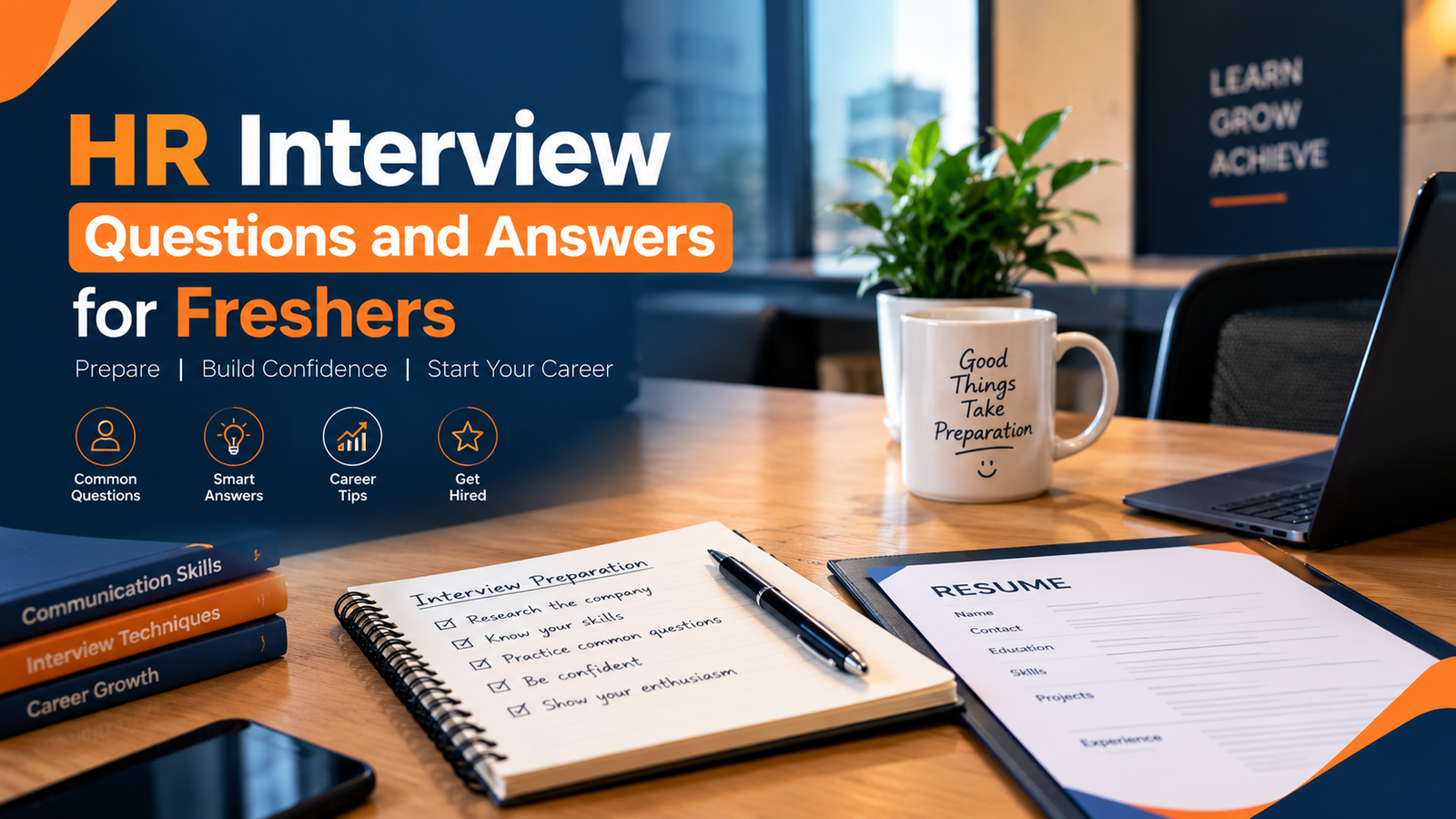
The HR round is where many freshers lose an offer they had already earned in the technical round, simply because they were not ready for questions like "Why should we hire you?" or "What is your weakness?" This guide covers the HR interview questions for freshers that come up again and again, explains what the interviewer is really checking, and gives you a sample answer for each one that you can adapt to your own honest story.
You will find 22 questions grouped by topic, a simple method for structuring any answer, the STAR method for behavioural questions, templates, body language tips, a day-before checklist and the mistakes to avoid. Every sample answer is a fictional example, so replace the details in brackets with your own true experience. Interviewers can usually tell when an answer is borrowed, and a true answer is also the only one you can defend in follow-up questions.
|
Quick answer: Answer every HR question in three parts: a direct answer, one real example, and a line that links it to the role. Keep answers to about a minute, use the STAR method for "Tell me about a time..." questions, research the company, and never invent facts. |
|
Explore VibrantMinds VibrantMinds Technologies is a Pune-based IT training and recruitment company. Learn more about its courses and placement process, or visit the candidate portal. |
What Is the HR Round and What Do HR Interviewers Look For?
The HR round usually comes after the technical round, though the order varies by company. It is less about code and more about you: how you communicate, how you think about work, and whether you fit the role and the team. HR interviewers are generally listening for five things.

Notice that none of these is "memorised answer." Interviewers can often tell a recited paragraph from a real one. Clear structure, honest examples and a calm tone matter more than perfect wording.
How to Answer HR Interview Questions: A Simple Method
Use this three-part structure for almost every question:
1. Answer directly. Start with the point in one sentence.
2. Back it with one real example. A short true story beats a general claim.
3. Link it to the role. Finish by connecting the answer to the job you are applying for.
For behavioural questions that start with "Tell me about a time when...", use the STAR method. It keeps your story organised and stops you from rambling.

STAR TEMPLATE
Situation : In my [final-year project / training / internship], [what was happening].
Task : I was responsible for [your part].
Action : I [step 1], then [step 2], and [step 3].
Result : [Outcome]. I learned [one lesson you still use].
Most Common HR Interview Questions for Freshers
The map below groups the 22 questions covered in this guide. Prepare at least one honest, practised answer for each tile, then adapt them to each company.

HR Questions About You and Your Motivation
Q1. Tell me about yourself
What they check: communication, clarity and whether you can summarise yourself in a minute. Use present, past and future: who you are and what you focus on, one project or training that proves it, and the role you want next. Keep it to about 60 to 90 seconds.
Sample answer: I'm [Name], a [degree] graduate from [college], Pune. Over the last year I've focused on [skill], and I built [project] that [what it does]. I'm now looking for an entry-level [role] where I can learn from a strong team and contribute to real projects.
Q2. Why do you want to work in IT or software?
What they check: whether your interest is genuine or just following a trend. Give a specific reason rooted in something you have actually done, not "IT has good scope."
Sample answer: I enjoy solving problems, and software lets me see my work being used. When I built [project] and it finally worked end to end, I wanted to feel that every day. IT also keeps teaching me new things, which suits the way I like to learn.
Q3. Why do you want to join our company?
What they check: preparation and genuine interest. Research the official website, the products or services, recent news and the job description. Pick two or three real facts and one honest reason. Never praise something you have not verified.
Sample answer: I read that [Company] works in [domain] and builds [product or service]. I like that [specific verified fact, for example, freshers work on live projects]. My skills in [skill] match this role, and I'd like to grow in a team that [specific reason].
Q4. Why should we hire you?
What they check: confidence without arrogance. Do not compare yourself with other candidates. Describe what you bring: relevant skills, proof, learning ability and commitment.
Sample answer: I have solid fundamentals in [skills], and I've shown I can apply them by building [project]. I learn quickly, I take feedback well, and I'm committed to growing in this role. I'd work hard to become useful to the team from the first few weeks.
Q5. What do you know about our company?
What they check: whether you did basic homework. Prepare quickly with this checklist:
• Read the About, Products or Services and Careers pages on the official website.
• Check recent news or announcements, and note the industries the company serves.
• Re-read the job description and match two of your skills to it.
Prepare three facts and one reason, and say them in your own words. Do not read out a Wikipedia summary.
HR Questions About Strengths, Weaknesses and Personality
Q6. What are your strengths?
What they check: self-awareness and relevance. Pick two strengths that matter for the job and prove each with a small example.
Sample answer: One strength is consistency. When I was learning [Java], I practised daily for [a few weeks] and built [project] step by step. Another is that I ask questions early when I'm stuck instead of losing time. Both help me learn faster in a team.
Q7. What is your biggest weakness?
What they check: honesty and growth. Avoid fake weaknesses such as "I work too hard," and avoid anything that disqualifies you for the role. Pick a real, minor weakness and show what you are doing about it.
Sample answer: I used to spend too long trying to solve problems alone. I realised it slowed me down, so now I set a time limit. If I'm still stuck after that, I ask a senior or read the documentation. It has made me faster, and I'm still practising it.
Q8. How do you handle pressure or stress?
What they check: maturity and coping method. Describe a real method, such as breaking work into smaller tasks, prioritising and communicating early.
Sample answer: I break the work into smaller tasks and prioritise. During my final-year project demo, [an issue] appeared the day before. I listed what was broken, fixed the most important part first and told my team what to expect, and we presented on time.
Q9. What are your hobbies and interests?
What they check: personality and, sometimes, a friendly warm-up. Mention one or two genuine interests and connect them to a useful trait when it is natural. Do not invent hobbies.
Sample answer: I play cricket in a local team on weekends, which taught me teamwork and staying calm under pressure. I also enjoy building small projects, like [project], in my free time.
Behavioural HR Interview Questions (Use the STAR Method)
Q10. Tell me about a challenge you faced and how you solved it
What they check: problem solving and ownership. Choose a real challenge, ideally technical or academic, and walk through STAR.
Sample answer: During my final-year project, the login module kept failing for some users. I was responsible for fixing it before the demo. I reproduced the issue, found that extra spaces in usernames were not being trimmed, added input validation and wrote test cases. The module then worked consistently and we presented without errors. I learned to test edge cases early.
Q11. Tell me about a time you worked in a team or handled a conflict
What they check: teamwork and emotional maturity. Show that you listened, found a fair way forward and kept the relationship intact. Never blame teammates.
Sample answer: In a team project, two of us disagreed about the design. We listed the pros and cons of each approach, tested both quickly and chose the one that was simpler to maintain. The project finished on time and we stayed on good terms.
Q12. Tell me about a failure or mistake
What they check: honesty and learning. Pick a real mistake that is not catastrophic, say what you learned and show how you changed your behaviour.
Sample answer: In my first mini-project, I skipped planning, and the code became hard to change. I restarted with a simple design document, which taught me to plan first. My next project went much more smoothly.
Q13. How do you handle criticism or feedback?
What they check: coachability. Show that you listen, do not get defensive and act on feedback.
Sample answer: I treat feedback as free learning. When my trainer pointed out that my code was hard to read, I started using clearer names and comments, and asked for another review a week later to check my progress.
HR Questions About Career Goals
Q14. Where do you see yourself in five years?
What they check: ambition and commitment. Give a realistic path connected to this role. Avoid "in your chair" jokes or vague answers like "somewhere better."
Sample answer: In five years I'd like to be a confident developer who owns modules end to end, has strengthened my skills in [area] and helps newer team members. In the first year, I want to learn the company's tools and processes properly.
Q15. How do you keep learning new technologies?
What they check: growth mindset, which matters a great deal in IT. Name a real habit with a recent example.
Sample answer: I set weekly learning goals, build small projects with new tools and read official documentation. Recently I learned [topic] by building [small project], which helped me understand it much better than watching videos.
Practical HR Interview Questions for Freshers
Q16. What are your salary expectations?
What they check: realism and flexibility. Research typical fresher compensation for the role, company type and city using current job listings, and avoid quoting a number you cannot justify. If you are asked directly, give a reasoned, researched answer and show that you are open to discussion. Do not bring up salary first in the opening minutes.
Sample answer: At this stage I'm focused on learning and growth, and I expect a salary in line with the company's fresher structure and market norms. If you can share the range for this role, I'd be happy to discuss it.
Q17. Are you willing to relocate or work in shifts?
What they check: flexibility and honesty. Say yes only if you mean it, since backing out later hurts your credibility. If you have genuine limits, state them calmly and ask for details about the role.
Sample answer: Yes, I'm open to relocating [if true]. For shifts, I'm flexible within [your honest limit], and I'd like to understand the typical schedule for this role.
Q18. Why is there a gap in your education or a backlog on your record?
What they check: honesty and how you handled the situation. Do not hide it or invent dates. Give one honest line, then show what you learned or built during that time.
Sample answer: I had a gap of [duration] because [brief honest reason]. I used that time to complete [course] and build [project]. It taught me discipline and self-learning, and I'm ready to focus fully on my career now.
Q19. Do you have any other job offers?
What they check: interest level and honesty. Answer truthfully. If you have none, say you are in the process with other companies if that is true, and explain why this role interests you.
Sample answer: I'm in the process with a couple of companies, but this role is a strong match for my skills in [skill], and I'm very interested in it.
Q20. When can you join?
What they check: availability. Give an honest date, accounting for exams, results or notice periods if you are currently working.
Sample answer: I can join [immediately / after my final exams on (date) / within (number) weeks].
Q21. Are you comfortable with a service agreement?
What they check: commitment, and whether you understand the terms. Some companies ask freshers to sign a service agreement. Ask HR to explain the duration, the conditions and any amounts involved, read every line before signing, and never sign something you do not understand. Be cautious about anything that asks you to pay money upfront.
Sample answer: I'm committed to building my career here. Could you please share the agreement's duration and terms so I can read them carefully before I decide?
Q22. Do you have any questions for us?
What they check: curiosity and preparation. Always ask two or three thoughtful questions. Do not ask about salary, leave or holidays first.
• What does a typical first month look like for a fresher in this team?
• What training or mentoring do new joiners receive?
• Which technologies or tools would I work with?
• How is performance reviewed in the first year?
• What are the next steps in the hiring process?
Body Language and Communication Tips for the HR Round
• Greet clearly and smile. A confident hello sets the tone.
• Sit upright and keep eye contact. In video interviews, look at the camera, not your own face.
• Speak slowly. Nervous speakers rush. Pause briefly between points.
• Avoid filler words. A short silence sounds more confident than "umm."
• Listen fully before answering. Ask politely to repeat a question you did not catch.
• Test your setup for online rounds. Check light, audio, internet and a quiet background before you log in.
• Dress neatly. Clean, comfortable, professional clothing, following any instructions the company gave.
Common Mistakes Freshers Make in the HR Round
1. Memorising a script. It sounds robotic and breaks if the question changes.
2. Giving one-word answers. Use the three-part method for every answer.
3. Criticising a previous college, trainer or company. It signals attitude problems.
4. Claiming skills you do not have. The follow-up questions will expose it.
5. Asking only about salary and leave. Show interest in the work and growth.
6. Not researching the company. It takes ten minutes and shows effort.
7. Arriving late or unprepared. Reach early, or join the online link a few minutes before.
Your Day-Before Interview Checklist
• Re-read the job description and match two of your skills to it.
• Practise your introduction and the top six questions out loud.
• Prepare one project walkthrough and two STAR stories.
• Keep printed copies of your resume and documents, if the interview is in person.
• Plan your route, or test your internet, camera and microphone.
• Prepare two or three questions to ask the interviewer.
• Sleep well. A rested mind answers better than a crammed one.
After the HR Round: A Short Follow-Up Email
A brief thank-you email keeps you memorable and shows professionalism. Send it the same day or the next morning.
THANK-YOU EMAIL
Subject: Thank you - [Role] interview - [Your Name]
Dear [Interviewer's name],
Thank you for taking the time to speak with me today about the [Role]
position. I enjoyed learning more about [something specific from the
interview]. I remain very interested in the role and would be glad to
provide any further information you need.
Regards,
[Your Name] | [Phone]
About VibrantMinds Technologies
VibrantMinds Technologies Pvt. Ltd. is a Pune-based IT training and recruitment company. It operates as a talent ecosystem that connects candidates, colleges and companies, with 1900+ partner colleges and 600+ hiring companies in its network.
Visit vibrantminds.in to learn about the company, or open the candidate portal at candidates.vibrantminds.in.
These are the VibrantMinds courses:
|
Course |
Duration |
Key topics |
|
Full Stack Java Development |
4–6 months |
Core Java, OOP, SQL and JDBC, web fundamentals, backend frameworks, front-end basics, projects |
|
Software Testing (Manual + Automation) |
2–5 months |
Testing fundamentals, test cases, bug reporting, SDLC and STLC, automation basics, interview preparation |
|
Core Java |
1–2 months |
Syntax, OOP, strings, collections, exception handling, practice programs |
|
Python & Data Science |
2–4 months |
Python basics, data handling, analysis libraries, visualisation, introduction to machine learning |
How VibrantMinds Helps You Prepare for the HR Round and Beyond
Good HR answers depend on having real things to talk about: skills you can explain, projects you built and training you completed. That is where structured learning helps. Core Java, Full Stack Java Development, Software Testing and Python & Data Science each give you material for the "proof" part of every answer, such as projects, test cases and analysis work. The Software Testing course also lists interview preparation among its topics.
The VibrantMinds 6-step placement pipeline connects that preparation to real openings:
1. Requirement Mapping: understanding what hiring companies need, so your preparation matches real requirements.
2. Candidate Sourcing: identifying candidates who fit those openings.
3. Screening & Assessment: checking skills and readiness, so gaps surface before a real interview.
4. Drive Coordination: organising recruitment drives with hiring companies.
5. Interview Support: preparing candidates for interview rounds, including the HR round covered in this guide.
6. Onboarding Follow-up: staying in touch after selection to support the joining process.
|
VibrantMinds tip Want to practise before the real interview? Ask the team how interview support, assessments and mock interviews work in the batch you are considering. |
Real Outcomes: What Past Students Say
Feedback shared by past students mentions placements with companies such as Aress Software and Education Technologies, Saama Technologies and Three M Software. To be clear and fair: outcomes vary from person to person, depending on skills, effort, attendance, interview performance and company requirements. Nothing here is a guarantee of a job, so please confirm details directly with the VibrantMinds team before you decide.
Connect With VibrantMinds Technologies
Address: Viva Academy Building, Warje, Pune, Maharashtra 411052
Phone: +91 95035 79517
Email: support@vibrantmindstech.com
Website: https://vibrantminds.in/
Candidate portal: https://candidates.vibrantminds.in/
Join the Job-Update WhatsApp Groups
Group 1: https://chat.whatsapp.com/CUCS1derlmTFee2c9dyUHd
Group 2: https://chat.whatsapp.com/FvMf1fGYQYnHppQ8AwFX40
Group 3: https://chat.whatsapp.com/I7RNnGMkb2L8S8HibdyWpQ
|
Caution: never pay anyone to apply for a job or to get shortlisted. If someone asks for money in exchange for a job opportunity, stop and verify directly with the company or the VibrantMinds team. |
Frequently Asked Questions About the HR Interview
How long should my answers be in the HR round?
Aim for about 60 to 90 seconds for most answers. That is long enough to give a direct answer, an example and a link to the role, and short enough for the interviewer to ask a follow-up.
Is the HR round easier than the technical round?
Not necessarily. It tests different things: communication, attitude, honesty and fit. Candidates who are strong technically can still be rejected if their answers show poor preparation or attitude, so prepare for both.
What should I wear for an HR interview?
Wear clean, comfortable, professional clothing, and follow any dress instructions the company provides. For online interviews, dress as you would in person, since it also helps you feel focused.
What should I do if I am very nervous?
Prepare thoroughly, practise out loud, breathe slowly before you start and pause before answering. A short pause looks thoughtful, not weak. Nervousness is common and interviewers expect it from freshers.
Can I say "I don't know" in the HR round?
If you truly do not know, say so calmly, share what you do know and explain how you would find out. Honest reasoning is better than guessing confidently.
What if the HR asks my salary expectation on the first call?
Research typical fresher ranges for the role and city first. Give a reasoned answer, show flexibility and ask about the company's range for the role. Avoid quoting a number you cannot justify.
Should I carry documents to the interview?
Yes, for in-person rounds, carry printed copies of your resume, ID, mark sheets and any documents mentioned in the interview call. Keep them neatly organised in a folder.
How do I follow up after the interview?
Send a short, polite thank-you email within a day, as shown in this guide. If you have not heard back in the timeframe the company gave, send one brief follow-up asking about the status.
Final Thoughts: Be Prepared, Be Honest, Be Yourself
HR interviews reward preparation and honesty far more than clever answers. Prepare one true example for each question group, practise out loud until the structure feels natural, research the company, and keep your tone calm and respectful. If you do not have an answer ready, take a breath and think. A pause is better than a rushed ramble.
If you would like help building the skills and projects that give you strong answers, or want to understand how VibrantMinds courses and placement support work, the team is happy to talk it through.