How to Build a Job-Ready IT Profile as a Fresher in 2026
Getting an IT job as a fresher is not only about having a degree or completing a programming course. Many graduates know the basics of coding but still struggle to get shortlisted because their skills, projects, resume, communication, and interview preparation do not come together as one job-ready profile.
If you are preparing for software jobs in 2026, the better question is not, “How many technologies should I learn?” It is, “What should my profile prove to a recruiter?”
This guide explains how freshers can build a practical IT profile, which skills matter, what projects to create, how to prepare a resume, and how to become more confident during technical interviews.
What Does a Job-Ready IT Profile Mean?
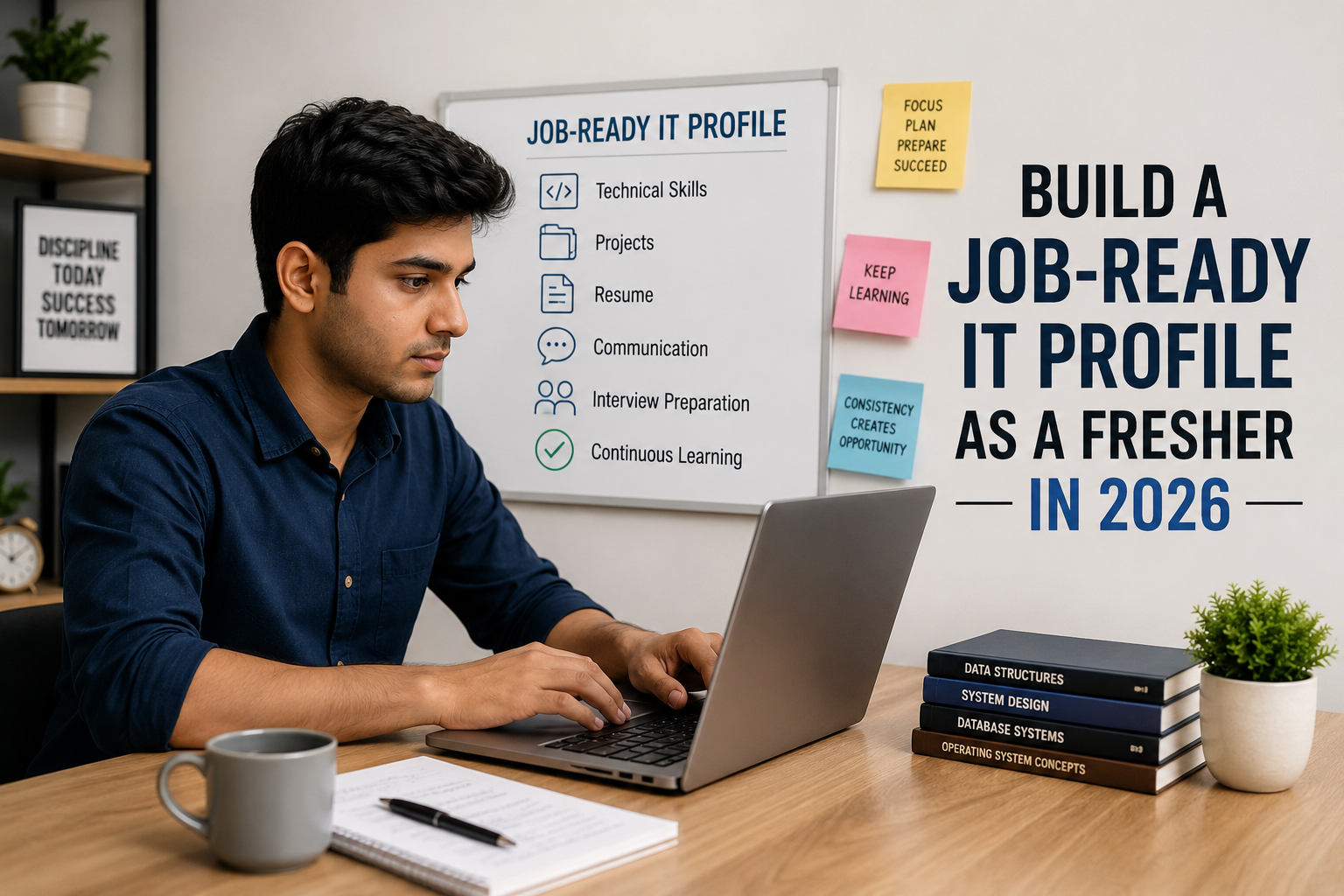
A job-ready IT profile is a combination of technical skills, practical projects, problem-solving ability, communication, resume quality, and interview preparation that shows you can apply what you have learned.
For a fresher, being job-ready does not mean knowing every programming language or technology.
It means being able to:
-
Explain your technical fundamentals clearly
-
Write and understand basic-to-intermediate code
-
Work with databases
-
Build at least one meaningful project
-
Explain your project and your contribution
-
Solve common programming and logical problems
-
Create a clear, relevant resume
-
Communicate professionally
-
Handle technical and HR interview questions
-
Continue learning when you encounter something unfamiliar
The goal is to demonstrate practical ability, not simply collect certificates.
Why Many Freshers Struggle to Get IT Jobs
A common problem is that a graduate's profile looks good on paper but does not demonstrate enough practical ability.
For example, a fresher may have:
BE/BTech + Multiple Certificates + Programming Course
but struggle when asked:
-
What did you build?
-
Why did you choose this technology?
-
How does your application work?
-
How does your database connect with the application?
-
What problem does your project solve?
-
What challenges did you face?
-
How would you improve the project?
This creates a gap between learning and demonstrating skills.
A stronger profile connects everything:
Learn → Practice → Build → Explain → Prepare → Apply → Improve
That is the foundation of becoming job-ready.
Which Skills Should Freshers Learn for IT Jobs?
You do not need to learn every technology available in the market. Start with a clear career direction and build the skills required for that path.
For example, someone targeting a full-stack development role could focus on:
| Skill Area | What to Learn |
|---|---|
| Programming | Java, C#, JavaScript or another suitable language |
| Programming Fundamentals | Variables, loops, functions, OOP, error handling |
| Problem Solving | Basic DSA, logical thinking and coding practice |
| Database | SQL, queries, joins, database concepts |
| Frontend | HTML, CSS, JavaScript and relevant frontend concepts |
| Backend | Framework and API development |
| Development | REST APIs, application architecture and debugging |
| Tools | Git, IDEs and basic development workflow |
| Professional Skills | Communication, teamwork and problem-solving |
The important point is depth before unnecessary breadth.
Learning five programming languages at a basic level is usually less useful than becoming confident in one primary language and understanding how it works in real applications.
Choose One Primary Career Direction
One of the biggest mistakes freshers make is trying to prepare for every IT role simultaneously.
A better approach is to choose a target direction.
You could explore areas such as:
-
Full Stack Development
-
Java Development
-
.NET Development
-
Software Testing
-
Data-related roles
-
Frontend Development
-
Backend Development
Your choice should influence what you learn, what projects you build, and how you prepare your resume.
For example, if your goal is Java Full Stack Development, your preparation can progressively move from:
Core Java → OOP → SQL → HTML/CSS/JavaScript → Advanced Java → Hibernate → Spring → Spring Boot → REST APIs → Full-Stack Project
This creates a much clearer profile than randomly collecting technologies.
Build Projects That Demonstrate Your Skills
Projects are one of the most useful ways for a fresher to demonstrate practical learning.
But simply writing:
“Developed a web application.”
does not tell a recruiter much.
A stronger project should allow you to explain:
-
What problem does the project solve?
-
Who is the intended user?
-
Which technologies did you use?
-
Why did you choose them?
-
How does the application work?
-
What database did you use?
-
What features did you implement?
-
What problems did you face?
-
How did you solve those problems?
-
What would you improve in the future?

Examples of Practical Fresher Projects
Depending on your career path, you could build projects such as:
-
Job Portal
-
Employee Management System
-
Student Management System
-
E-Commerce Application
-
Expense Tracker
-
Appointment Management System
-
Online Examination System
-
Inventory Management System
-
Task Management Application
-
Learning Management System
The project does not need to be extremely complicated.
A well-understood project with meaningful functionality is more valuable than a complicated project that you cannot explain.
What Makes a Fresher Project Strong?
A good project should demonstrate more than a user interface.
For a full-stack application, for example, you could demonstrate:
Frontend
→ User interface
→ Forms
→ Validation
→ Responsive design
Backend
→ Business logic
→ APIs
→ Authentication
→ Error handling
Database
→ Tables
→ Relationships
→ SQL queries
→ CRUD operations
Application
→ Frontend communicates with backend
→ Backend communicates with database
→ Data is processed and displayed to users
This gives you practical concepts to discuss during an interview.
Learn to Explain Your Project
Knowing how to build a project is important.
Knowing how to explain it clearly is equally important.
Prepare a simple explanation covering:
Project name → Problem → Solution → Technologies → Features → Your contribution → Challenges → Result → Future improvements
For example:
“I developed a job portal that allows candidates to search for opportunities and manage applications. I used Java and Spring Boot for the backend, SQL for data management, and web technologies for the frontend. I worked on the authentication, job management and application modules. One challenge was handling different user roles, which I addressed by separating candidate and administrator access.”
The exact technologies will depend on your project, but the structure of the explanation should remain clear.
Your Resume Should Match Your Target Role
A fresher's resume does not need to contain everything they have ever learned.
It should contain the information that is most relevant to the role being targeted.
A practical fresher resume can include:
1. Professional Summary
Keep it short and relevant to your target role.
2. Technical Skills
List technologies you actually understand.
3. Projects
Mention your strongest projects and explain your contribution.
4. Education
Include your degree, specialization and relevant academic details.
5. Certifications
Include relevant certifications rather than filling the resume with unrelated certificates.
6. Achievements
Mention meaningful technical, academic or extracurricular achievements when relevant.
Avoid adding skills simply because they appear in a job description.
If an interviewer asks about a technology listed on your resume, you should be prepared to discuss it.
Build a Resume Around Evidence
Instead of writing:
Knowledge of Java and SQL.
show evidence through your projects:
Developed a web application using Java and SQL with user authentication, database operations and role-based functionality.
The second statement gives the reader something concrete to understand.
Whenever possible, connect a skill to something you actually built, solved, tested or implemented.
Do Not Ignore SQL
Freshers preparing for development roles sometimes focus heavily on programming and neglect databases.
That can create problems during technical interviews.
Your SQL preparation should include concepts such as:
-
SELECT
-
WHERE
-
ORDER BY
-
GROUP BY
-
Aggregate functions
-
Joins
-
Subqueries
-
Constraints
-
Primary keys
-
Foreign keys
-
Normalization
-
Views
-
Stored procedures
-
Transactions
You should also practice writing queries rather than only memorizing definitions.
Strengthen Your Programming Fundamentals
Before moving into advanced frameworks, make sure your fundamentals are strong.
For a programming language such as Java, important areas can include:
-
Variables and data types
-
Operators
-
Conditional statements
-
Loops
-
Arrays
-
Strings
-
Methods
-
Classes and objects
-
Inheritance
-
Polymorphism
-
Encapsulation
-
Abstraction
-
Exception handling
-
Collections
-
Basic file handling
-
Basic problem solving
Frameworks become easier to understand when the underlying programming concepts are clear.
Practice DSA at the Right Level
Freshers do not necessarily need to spend all their preparation time solving extremely difficult problems.
Start with fundamentals:
-
Arrays
-
Strings
-
Searching
-
Sorting
-
Hashing
-
Stacks
-
Queues
-
Linked lists
-
Basic recursion
-
Basic complexity concepts
The objective is to develop problem-solving ability.
When you solve a problem, do not only look for the final answer. Ask yourself:
-
What is the simplest approach?
-
Can I improve it?
-
What is the time complexity?
-
What happens with an empty input?
-
What happens with duplicate values?
-
Can I explain my solution clearly?
This approach prepares you better for technical discussions.
Communication Is Part of Technical Preparation
Technical knowledge alone does not guarantee that you can communicate your ability effectively.
Practice explaining technical concepts in simple language.
For example, instead of memorizing a definition of inheritance, try explaining:
“Inheritance allows one class to acquire properties and behavior from another class, which can help with code reuse and creating relationships between classes.”
Then be ready to give a small example.
You should also practice:
-
Self-introduction
-
Project explanation
-
Technical explanations
-
Strengths and weaknesses
-
Career goals
-
Questions about your education
-
Questions about your projects
Prepare for Interviews Before You Start Applying
Interview preparation should not begin after you receive an interview call.
Prepare while building your skills.
Create an interview checklist:
Programming fundamentals
↓
SQL
↓
Projects
↓
DSA/problem solving
↓
Technical questions
↓
Self-introduction
↓
HR questions
↓
Mock interviews
This gives you time to identify weaknesses before an actual interview.

What Should Freshers Do Every Day?
You do not need to spend the entire day watching tutorials.
A practical routine could look like:
| Activity | Purpose |
|---|---|
| Learn a concept | Build knowledge |
| Write code | Improve implementation |
| Solve problems | Improve logical thinking |
| Work on project | Gain practical experience |
| Revise | Strengthen memory |
| Practice communication | Improve explanation skills |
| Review interview questions | Build interview readiness |
| Apply for suitable roles | Gain opportunities |
The exact schedule can vary according to your education, responsibilities and current skill level.
What matters most is consistent practical work.
Avoid These Common Fresher Mistakes
Learning Too Many Technologies
Do not constantly switch from Java to Python to .NET to another technology without becoming comfortable with your primary path.
Collecting Certificates Without Practice
A certificate can document learning, but it cannot replace practical understanding.
Copying Projects Without Understanding Them
If you cannot explain your own project, it becomes a weakness during interviews.
Creating a Generic Resume
Your resume should reflect the role you are targeting.
Ignoring Communication
Technical knowledge becomes difficult to demonstrate when you cannot explain your thinking.
Waiting Until You Feel "100% Ready"
You can continue improving while applying for suitable opportunities.
Applying Randomly
Understand the role requirements and apply when your skills reasonably match them.
How Can VibrantMinds Help You Build a More Structured Preparation Path?
For candidates who need structured guidance instead of trying to organize everything independently, VibrantMinds Technologies Pvt. Ltd. provides IT training and career preparation focused on practical learning.
For candidates interested in Java Full Stack Development, structured preparation can bring programming fundamentals, database concepts, backend development, frontend technologies, projects, aptitude, communication, group discussions and interview preparation into one learning path.
The important thing is to use training as a way to build actual skills, not simply complete a course.
A candidate should still practice independently, build projects, understand the concepts being taught and prepare for interviews.
A Practical 90-Day Job-Ready Plan
If you are starting from the basics, you can organize your preparation into stages.
Days 1–30: Build the Foundation
Focus on:
-
One primary programming language
-
Programming fundamentals
-
OOP concepts
-
SQL basics
-
Basic problem solving
-
HTML and CSS fundamentals
Your goal is to understand the building blocks rather than rushing into advanced frameworks.
Days 31–60: Start Building
Focus on:
-
Advanced programming concepts
-
Database operations
-
Backend fundamentals
-
APIs
-
Frontend development
-
Git and development workflow
-
Small practical applications
Start building your main project during this stage.
Days 61–90: Become Interview-Ready
Focus on:
-
Completing your project
-
Resume preparation
-
DSA practice
-
SQL interview questions
-
Technical revision
-
Project explanation
-
Mock interviews
-
Communication practice
-
Applying for relevant entry-level roles
By the end of the process, your objective should be a profile that can demonstrate what you know, not merely list what you studied.
How Do You Know If You Are Job-Ready?
Ask yourself these questions:
-
Can I explain my primary programming language?
-
Can I solve basic coding problems without copying solutions?
-
Can I write SQL queries?
-
Can I explain OOP concepts?
-
Can I build and explain a practical project?
-
Can I explain my own code?
-
Can I discuss the technical decisions in my project?
-
Can I create a focused resume?
-
Can I introduce myself confidently?
-
Can I answer basic technical interview questions?
-
Can I communicate when I do not know an answer?
If most answers are "yes," you are moving toward a stronger entry-level profile.
If several answers are "no," that is not a reason to stop. It tells you exactly where your preparation needs improvement.
Frequently Asked Questions
How can a fresher become job-ready for IT jobs?
A fresher can become job-ready by developing strong programming fundamentals, learning relevant technologies, building practical projects, practicing problem solving and SQL, creating a focused resume, improving communication and preparing consistently for technical and HR interviews.
How many programming languages should a fresher learn?
Start with one primary programming language and become comfortable using it. You can learn additional technologies later when they support your target career path.
Are projects important for freshers?
Yes. Projects give freshers an opportunity to demonstrate how they apply technical concepts. A well-understood project can also provide useful material for technical interview discussions.
Should freshers learn DSA?
Basic data structures and algorithms can help develop problem-solving skills and may be relevant to technical assessments and interviews. The required depth depends on the role.
Is SQL important for software development jobs?
SQL is useful for many software development roles because applications frequently interact with databases. Freshers should understand SQL fundamentals and practice writing queries.
Should a fresher put every skill on the resume?
No. Include skills that are relevant to the target role and that you can confidently discuss during an interview.
Can I get an IT job without knowing multiple programming languages?
Yes. Your preparation does not need to begin with multiple programming languages. A stronger understanding of one primary language, combined with relevant development skills and practical projects, can provide a better foundation.
How many projects should a fresher have?
There is no fixed number. Focus on creating a small number of meaningful projects that you genuinely understand and can explain in detail.
Should I apply for jobs while I am still learning?
You can start exploring suitable opportunities while continuing your preparation. Waiting until you feel perfect can unnecessarily delay your job search. At the same time, apply for roles that reasonably match your current skills.
How can I improve my technical interview performance?
Practice explaining fundamentals, solving coding and SQL problems, discussing your projects, answering common interview questions and participating in mock interviews. Reviewing your mistakes after every practice session can help you improve.
Is a certificate enough to get an IT job?
A certificate can show that you completed learning, but it does not replace practical skills. Employers may also evaluate your technical knowledge, projects, problem-solving ability, communication and interview performance.
Final Takeaway
Building a job-ready IT profile as a fresher is not about trying to learn everything.
It is about creating a focused combination of skills, practical experience, projects, communication and interview preparation that you can confidently demonstrate.
Choose a career direction. Build strong fundamentals. Create projects you understand. Practice solving problems. Keep your resume focused. Prepare for interviews before opportunities arrive.
Most importantly, measure your progress by what you can build, explain and solve, not simply by how many courses or certificates you have completed.
For freshers who want structured IT training and career preparation, VibrantMinds Technologies can be part of that preparation journey. The final responsibility remains with the candidate: learn consistently, practice practically, build evidence of your skills, and keep improving.