
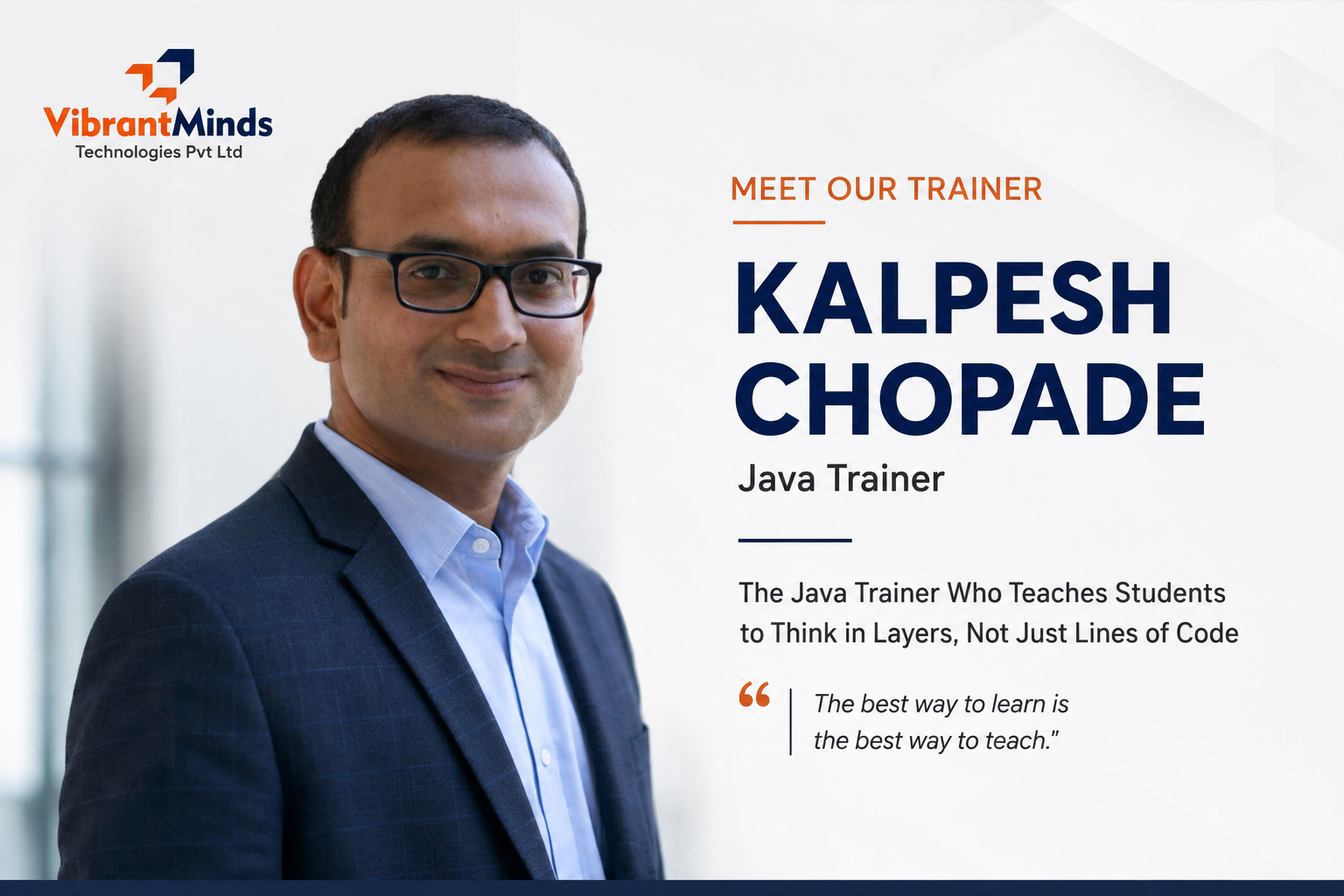
"The best way to learn is the best way to teach."
Ask any student who has just finished a Core Java course what they learned, and most will rattle off a list: classes, objects, inheritance, exception handling, maybe a bit of multithreading if the course went deep enough. Ask them to build something with it — a real application, with a database behind it and an API in front of it — and the confidence often disappears.
That gap between knowing Java and being able to use Java is where a lot of learners quietly get stuck. It isn't a knowledge problem. It's a translation problem — the distance between syntax on a screen and a working system that talks to a database, handles requests, and behaves the way a real application should.
It's also the exact gap Kalpesh Chopade has built his teaching around.
Meet Kalpesh Chopade: More Than a Java Trainer
Kalpesh Chopade works as a Java Trainer and Subject Matter Expert at VibrantMinds, where his focus sits squarely on Java and backend development — from the fundamentals of the language to the frameworks and systems that power real software.
His areas of expertise span Core Java, Advanced Java, Object-Oriented Programming, JDBC, SQL, Hibernate, Spring, Spring Boot, and REST APIs. But what stands out isn't just the list of technologies — it's the order in which he insists on teaching them. Before frameworks. Before shortcuts. Before “just copy this code and it'll work.” Fundamentals first.
In his Core Java sessions, that means real time spent on OOP concepts, exception handling, strings, arrays, and collections — not as topics to check off, but as ideas students need to be able to reason about. Multithreading, file handling, Java I/O, and Java 8 features get the same treatment. And notably, he pushes further than most introductory courses do: into how Java actually works under the hood — JVM behavior, memory management, the stack and the heap, garbage collection, how objects come into existence and how they're cleaned up.
It's the kind of depth that doesn't show up on a certificate, but shows up the moment a student is debugging a memory issue at 11 p.m. before a project deadline.
The Journey Behind the Trainer
Every trainer eventually forms a belief about what actually makes someone employable — and Kalpesh's is refreshingly unglamorous: fundamentals plus fluency, not a long list of tools.
His backend teaching reflects that. Students working with him move through JDBC and Hibernate/JPA for database interaction, then into Spring Core, Spring MVC, and Spring Boot for building structured applications, tying it all together with REST APIs and real database integration using MySQL and PostgreSQL.
But technology stacks alone don't make a developer. Alongside the frameworks, Kalpesh places consistent emphasis on problem-solving, database design, writing clean and maintainable code, debugging, and understanding how the different layers of a Java application actually talk to one another — because in his experience, that's usually the part students underestimate until they're standing in front of an interviewer trying to explain their own project.
What Kalpesh Chopade Believes About Learning
Ask a trainer what their philosophy is, and most will reach for something inspirational. Kalpesh reaches for something more practical — an idea that also happens to describe how he approaches his own sessions:
"The best way to learn is the best way to teach."
It's a simple line, but it says something specific about how he runs a classroom. He doesn't just deliver Java concepts to be memorized — he pushes students toward the point where they can explain what they've built, the same way a person only really understands something once they've had to teach it to someone else.
That's a meaningful distinction. A student who can recite what Hibernate does is different from a student who can explain, layer by layer, why their application is structured the way it is — and Kalpesh's classroom is built to close that exact gap.
A Teaching Approach Built Around Real Projects
Rather than teaching Java through isolated exercises, Kalpesh grounds his sessions in applications that mirror how real software is actually built.
A central example is a Student Management System — a project that touches student registration, updating and deleting records, searching, pagination, and full database operations. The stack behind it is deliberately realistic: Java, Spring Boot, Spring MVC, Hibernate/JPA, REST APIs, MySQL, and Thymeleaf.
Beyond that, students working with him engage with CRUD operations, relational database mapping, pagination, and custom queries — the unglamorous but essential mechanics of backend development.
What makes this approach different is the structure underneath it. Kalpesh designs these projects to demonstrate how a real application separates into distinct layers — Controller, Service, Repository/DAO, Entity/Model, and Database — and his role goes beyond simply assigning the project. He's involved in designing the application structure, implementing backend functionality, integrating the database, building the APIs, and debugging issues alongside students, using the project itself as the teaching material.
Because a Java concept explained on a whiteboard and a Java concept holding together a working application are two very different kinds of understanding.
What Makes Kalpesh Chopade's Training Approach Different?
• Fundamentals before frameworks — internal Java behavior (JVM, memory, garbage collection) is treated as core knowledge, not an afterthought
• Layered project thinking — every project is taught through the lens of Controller, Service, Repository, Entity, and Database, mirroring real application architecture
• Explanation over memorization — students are pushed to explain their own projects completely, not just complete them
• Realistic technology stacks — Spring Boot, Hibernate/JPA, MySQL, and REST APIs are taught together, the way they're actually used in industry
• Debugging as a skill, not a fallback — problem-solving and troubleshooting are built into the learning process, not treated as something students figure out later
From Learning to Confidence: How Learners Benefit
For learners going through Kalpesh's sessions, the payoff isn't a longer list of buzzwords on a resume — it's the ability to sit in front of someone and talk through a project they actually understand.
That includes being able to explain the problem a project solves, the design decisions behind it, the technologies chosen, the database structure, the API flow, and — critically — their own individual contribution to it. In Kalpesh's view, that last part is often the difference between a student who did a project and a student who can genuinely own it.
Because job-readiness was never about the number of technologies on a resume. It's about the confidence to build something and defend it.
Advice for Freshers: What Kalpesh Recommends
Kalpesh is direct about what he believes freshers need to focus on if they want to be genuinely job-ready as Java developers:
• Core Java and Object-Oriented Programming
• Collections and exception handling
• Multithreading and basic concurrency
• SQL and relational databases
• JDBC and database connectivity
• Hibernate/JPA
• Spring and Spring Boot
• REST API development
• Git and GitHub
• Data Structures and Algorithms
• Debugging and problem-solving
• The ability to build and explain real Java projects
He also stresses the practices that surround the code itself — layered architecture, API design, database design, version control, testing, and clean coding habits. In his words, freshers should be able to walk into a conversation and talk through a project completely: the problem it solves, how it's designed, what it's built with, how the database is structured, how the API flows, and what they personally contributed.
"Being job-ready is not about knowing the maximum number of technologies. It is about having strong fundamentals and the confidence to build and explain something yourself."
Kalpesh Chopade at a Glance
|
Trainer |
Kalpesh Chopade |
|
Domain |
Java & Backend Development |
|
Role |
Java Trainer & Subject Matter Expert |
|
Core Expertise |
Core Java, Advanced Java, OOP, JDBC, SQL, Hibernate, Spring, Spring Boot, REST APIs |
|
Training Focus |
Java fundamentals, backend architecture, real-world project building |
|
Institute |
VibrantMinds |
|
GitHub |
github.com/kalpesh162 |
What Learners Can Take Away
• A solid grasp of Core Java fundamentals — including what's actually happening at the JVM and memory level
• Practical, hands-on experience with Spring Boot, Hibernate/JPA, and REST API development
• An understanding of how real applications are structured into layers, not just how to write isolated code snippets
• The ability to work with relational databases through JDBC, MySQL, and PostgreSQL
• Stronger debugging and problem-solving instincts, built through real project work
• The confidence to explain a project completely — its design, its technology, and their own role in building it
Kalpesh's Role at VibrantMinds
At VibrantMinds, Kalpesh's contribution centers on turning Java from a subject students study into a skill they can actually apply. His sessions combine language fundamentals with backend frameworks and database integration, using real project structures — like the Student Management System — as the vehicle for that learning.
It's an approach that fits naturally into VibrantMinds' broader focus on practical, industry-relevant training: students don't just leave with notes on Spring Boot or Hibernate, they leave having built something they can walk an interviewer through, end to end.
Frequently Asked Questions
Who is Kalpesh Chopade?
Kalpesh Chopade is a Java Trainer and Subject Matter Expert at VibrantMinds, specializing in Core Java, Advanced Java, and backend development using Spring, Spring Boot, Hibernate, and REST APIs.
What does Kalpesh Chopade specialize in?
His core areas include Core Java and OOP fundamentals, JVM and memory management concepts, JDBC and database integration, Hibernate/JPA, Spring Boot, and REST API development, along with practical project-based learning.
What makes Kalpesh Chopade's training approach different?
He teaches Java through the lens of complete, layered applications — Controller, Service, Repository, Entity, and Database — rather than isolated exercises, and pushes students to be able to fully explain the projects they build.
How can Java training help learners build a career?
Structured Java training that combines fundamentals with real backend frameworks and database work helps learners move beyond theoretical knowledge toward being able to build, explain, and defend real applications — a key expectation in technical interviews.
Why is practical, project-based Java training important?
Because understanding a concept and being able to apply it inside a working, multi-layered application are two different skills. Project-based training closes that gap by requiring students to connect Java fundamentals, frameworks, and databases into a functioning system.
Where does Kalpesh Chopade train students?
Kalpesh Chopade trains students at VibrantMinds, focusing on Java and backend development for learners looking to build strong, job-ready technical foundations.
For learners looking to move beyond textbook Java and build the kind of backend skills that hold up in a real interview or a real project, training grounded in fundamentals, frameworks, and full-stack thinking can make that transition considerably more manageable.