
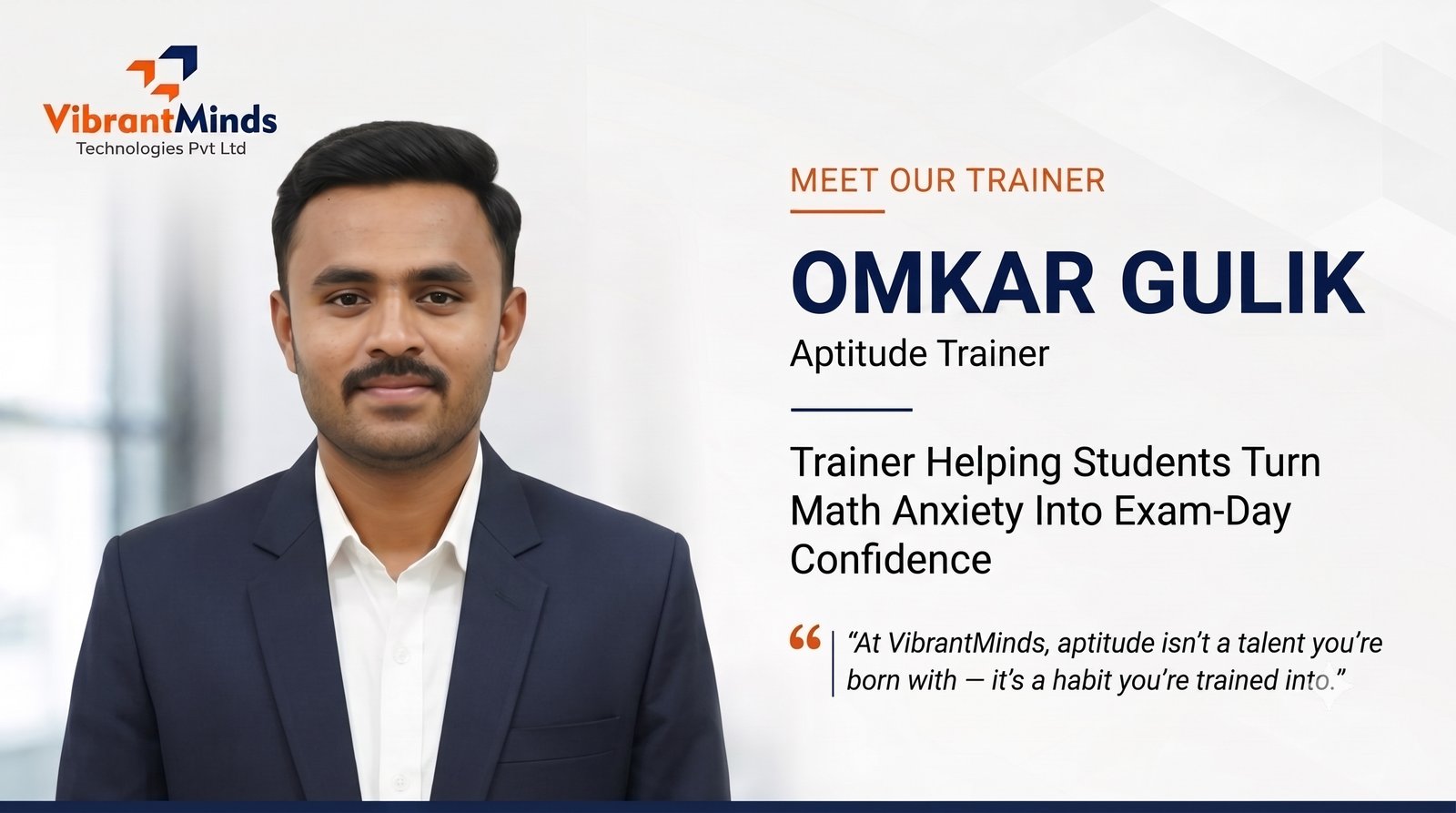
At VibrantMinds, aptitude isn’t a talent you’re born with — it’s a habit you’re trained into.
There is a particular kind of frustration every aptitude student knows. You understand the concept. You have solved a version of this exact question before. And yet, the moment the clock starts ticking in an exam hall, the numbers blur, the method disappears, and a question that should take ninety seconds stretches into four minutes of second-guessing.
It is rarely a knowledge problem. More often, it is a confidence problem wearing a math costume.
This is the exact gap that Omkar Gulik, Aptitude Trainer and Subject Matter Expert at VibrantMinds, has built his entire teaching approach around — not simply explaining formulas, but rebuilding the way students think under pressure.
Meet Omkar Gulik: More Than an Aptitude Trainer
At VibrantMinds, Omkar Gulik specialises in Quantitative Aptitude and Logical Reasoning, the two pillars that decide outcomes in placement tests, competitive examinations, and corporate hiring assessments. His subject range covers the areas that most frequently trip up learners — Number System, LCM & HCF, Percentages, Ratio & Proportion, Averages, Profit & Loss, Time & Work, Time-Speed-Distance, Simple & Compound Interest, Simplification, and Data Interpretation, alongside the core areas of Logical Reasoning.
A B.Tech. graduate in Computer Engineering, Omkar approaches aptitude the way an engineer approaches a system — by breaking it into its smallest working parts before putting it back together. That instinct to diagnose before prescribing shapes almost everything about how he runs a session.
The Journey Behind the Trainer
Omkar's comfort with Mathematics and Reasoning was sharpened long before he stepped into a training room, through his own preparation for competitive government examinations. That period taught him something that no textbook could: exactly where students lose time and marks, and why. It is a perspective he now brings into every VibrantMinds classroom, not as a story he tells, but as the lens through which he teaches.
Since 2023, that lens has been focused entirely on the students in front of him at VibrantMinds — identifying where their fundamentals are shaky, rebuilding those fundamentals from the ground up, and training them to solve with the speed and composure that real exams demand.
What Omkar Believes About Learning
Ask Omkar what separates a student who struggles with aptitude from one who doesn't, and his answer has nothing to do with natural talent.
“Aptitude is not about being naturally gifted at Mathematics; it is about developing the right concepts, approach, practice, and mindset.”
It is a belief he repeats often enough that it has become something of a working principle in his sessions: concept clarity builds the foundation, practice develops accuracy, speed comes with experience, and confidence brings consistency. Each piece depends on the one before it — which is why he refuses to let students skip straight to shortcuts before they have earned them.
Because a shortcut without understanding is just a trick waiting to fail on a different question.
A Teaching Approach Built Around Real Learners
Omkar's sessions rarely start with the hardest question in the chapter. They start with a diagnosis.
For students who come in weak in Mathematics, he first identifies exactly where their fundamentals break down, rather than pushing them straight into difficult problem sets. From there, he builds understanding progressively — starting with basic concepts and simple applications before layering in complexity.
He is deliberately cautious about formulas learned by rote. Instead, he walks students through the logic behind a concept and shows how that same logic plays out across different question patterns. Only once that foundation is solid does he introduce calculation shortcuts and time-saving techniques — tools that make sense because the student already understands what they are shortcuts for.
Speed is trained separately, and deliberately, through regular timed practice and structured tests. Alongside the numbers, Omkar treats confidence-building as a core part of the curriculum rather than an afterthought, because he has consistently seen students underperform not from lack of ability, but from approaching Mathematics with fear or self-doubt.
What Makes Omkar's Training Approach Different?
Four ideas run through everything Omkar teaches at VibrantMinds:
• Concept clarity before complexity — no shortcut is introduced until the underlying logic is understood.
• Speed built on accuracy — timed practice comes after fundamentals, never instead of them.
• Real, current question patterns — drawn from the kind of assessments students will actually face in placements, competitive exams, and corporate hiring.
• Confidence as a trained skill — treated with the same seriousness as any formula or method.
He also pushes students to build the habit of question analysis after every test — reviewing not just what went wrong, but why, and how to recognise that pattern earlier next time. It is a small habit that, repeated consistently, changes how students walk into an exam hall.
From Learning to Confidence: How Learners Benefit
The clearest evidence of Omkar's approach shows up in where his students end up. Learners he has trained and mentored at VibrantMinds have gone on to clear a wide spread of competitive and recruitment examinations, including selections in PSI, Staff Selection, Police Constable, Indian Army, Railways, Banking, and various other government examinations, alongside aptitude rounds in corporate hiring processes.
But the numbers, for Omkar, are really a proxy for something less visible: a student who once treated Mathematics as an obstacle learning to treat it as a tool. That shift — from hesitation to willingness to attempt a question — is what he describes as the most fulfilling part of training.
Because the real transformation isn’t just clearing an exam. It’s no longer flinching at the sight of a word problem.
Omkar’s Message to Learners
When asked what he most wants students to carry with them, Omkar doesn’t point to a formula or a shortcut. He points to a starting point — the belief that improvement is available to anyone willing to put in the work.
“You don’t need to be perfect to start; you just need the right guidance and the willingness to improve. With the right concepts, consistent practice, and confidence, your aptitude can become your strength — and your goal can become your achievement.”
It is a message he returns to often with students who walk in convinced they are simply “not good at Maths.” For Omkar, that belief is rarely true — it is usually just an unaddressed gap, waiting for the right structure and enough practice to close it.
Trainer at a Glance
|
Trainer |
Omkar Tanaji Gulik |
|
Designation |
Aptitude Trainer – Subject Matter Expert |
|
Domain |
Quantitative Aptitude & Logical Reasoning |
|
Education |
B.Tech., Computer Engineering |
|
Training Focus |
Concept clarity, speed, accuracy, and exam confidence for placements, competitive exams, and corporate hiring assessments |
|
Institute |
VibrantMinds |
What Learners Can Take Away
• A structured way to identify and fix weak fundamentals instead of guessing where the gaps are.
• A clear method for approaching unfamiliar aptitude questions logically, rather than freezing under pressure.
• Calculation techniques and shortcuts that are understood, not memorised — so they hold up under exam conditions.
• Regular exposure to timed practice that mirrors real placement and competitive exam formats.
• A habit of analysing mistakes after every test, turning each attempt into feedback for the next.
• Growing confidence in Mathematics and Reasoning as skills that can be built, not talents you either have or don’t.
Omkar’s Role at VibrantMinds
At VibrantMinds, Omkar's work sits at a point where academic preparation meets real-world readiness. His sessions are built to reflect the actual pressure of placement tests and competitive assessments, so that by the time students face the real thing, the format, the pace, and the pressure all feel familiar rather than foreign.
It is a contribution that fits naturally into how VibrantMinds approaches learning more broadly — not as information delivered once, but as a skill built through structured, honest, and consistent practice.
Frequently Asked Questions
Who is Omkar Gulik?
Omkar Tanaji Gulik is an Aptitude Trainer and Subject Matter Expert at VibrantMinds, specialising in Quantitative Aptitude and Logical Reasoning for competitive examinations, placement aptitude, and corporate hiring assessments.
What does Omkar Gulik specialise in?
His core areas include Number System, LCM & HCF, Percentages, Ratio & Proportion, Averages, Profit & Loss, Time & Work, Time-Speed-Distance, Simple & Compound Interest, Simplification, Data Interpretation, and Logical Reasoning.
What makes Omkar’s aptitude training approach different?
His training is built around four pillars — concept clarity, accuracy, speed, and confidence — with an emphasis on understanding the logic behind a method before learning shortcuts, backed by regular timed practice and test analysis.
How does Omkar help students who are weak in Mathematics?
He begins by identifying specific gaps in fundamentals, then rebuilds understanding progressively from basic concepts to advanced problems, while placing equal focus on building the student’s confidence.
Where does Omkar Gulik provide training?
Omkar trains students at VibrantMinds, working with learners preparing for placement tests, competitive examinations, and corporate hiring assessments.
Why is practical aptitude training important for placements and competitive exams?
Placement and competitive assessments test more than formulas — they test speed, accuracy, and decision-making under time pressure. Practical, timed training helps students build these skills in conditions that closely resemble the real exam.
Omkar’s Message to Learners
If there is one thing Omkar wants every student to walk away with, it isn’t a formula or a shortcut. It’s a shift in how they see themselves as learners of Mathematics and Reasoning in the first place.
“You don’t need to be perfect to start; you just need the right guidance and the willingness to improve. With the right concepts, consistent practice, and confidence, your aptitude can become your strength — and your goal can become your achievement.”
It is a message he returns to often, particularly with students who arrive convinced that aptitude simply isn’t “for them.” For Omkar, that belief is usually the biggest obstacle in the room — bigger than any actual gap in knowledge.
Ready to Build Real Aptitude Skills?
For learners who find Mathematics intimidating or feel their preparation lacks direction, the right guidance can turn that uncertainty into a plan — and eventually, into a result. At VibrantMinds, Omkar Gulik’s aptitude training is built to do exactly that: one concept, one habit, and one confident attempt at a time.