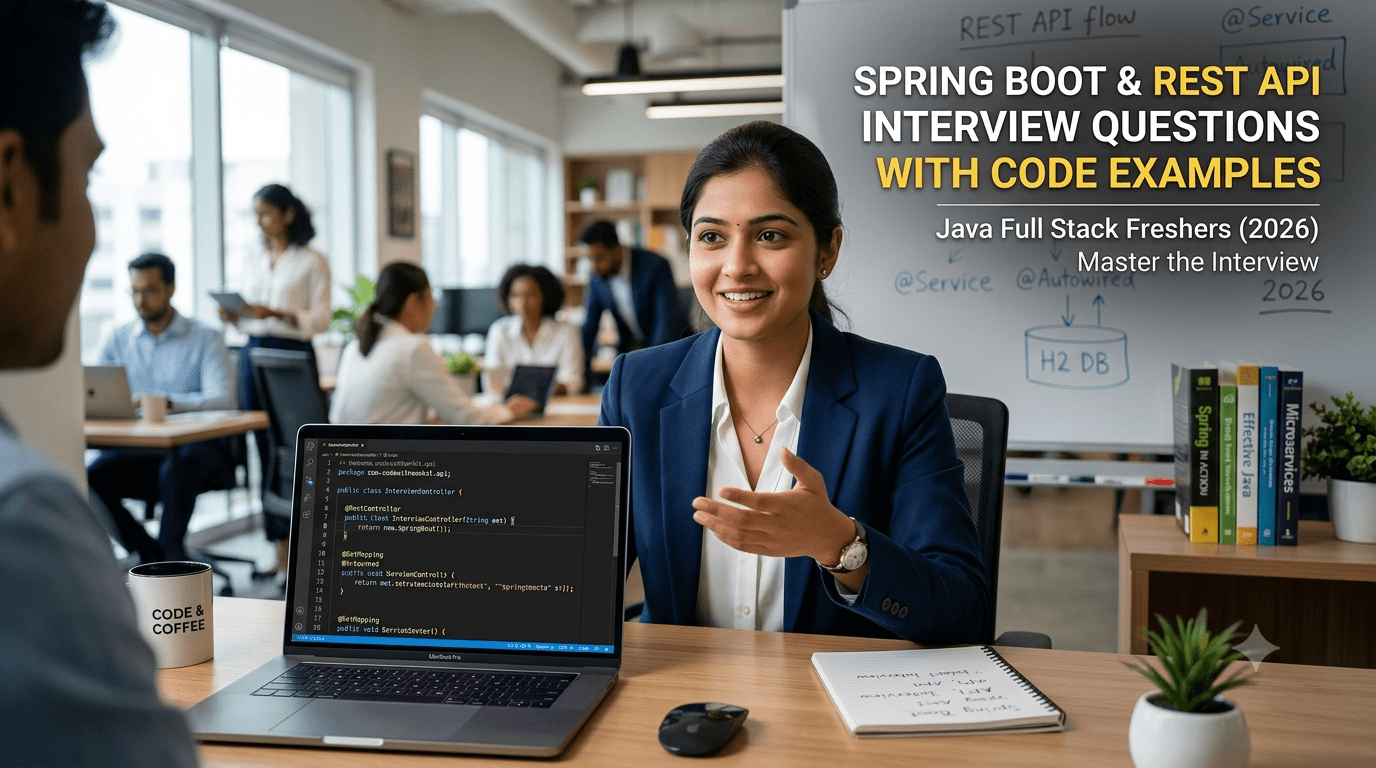
Complete Guide With Real Code, a 15-Day Practice Plan & Full VibrantMinds Technologies Course Details
If you are searching for Spring Boot interview questions for freshers, REST API interview questions with code, Spring Boot coding examples 2026, Java full stack developer Spring Boot preparation, REST controller example Java, or best IT training institute in Pune for Spring Boot training, this guide is built to be the most complete resource available on the topic. Once a fresher clears the Core Java and general coding round, Spring Boot and REST API knowledge becomes the next major filter in a Java full stack interview — and it is where many technically sound candidates lose ground, simply because they've studied Spring Boot in theory without ever writing a real REST controller or repository by hand. This is a long, detailed guide covering the most frequently asked Spring Boot and REST API concepts, each with complete, correct, ready-to-use code examples, a structured 15-day practice plan, and a full, accurate, link-free profile of VibrantMinds Technologies and its Full Stack Java training program.
Why Spring Boot and REST API Knowledge Is a Major Interview Filter
Spring Boot has become the default framework for building Java-based backend and full stack applications across Indian IT service companies, product companies, and GCCs alike. For a fresher, this means Spring Boot and REST API questions are almost guaranteed to appear once you clear the initial Core Java screening:

• REST API basics — building and consuming APIs — is the single most frequently tested area
• Dependency Injection is close behind, since it's the conceptual foundation of how Spring manages objects
• Spring Data JPA, exception handling, and core annotations round out the bulk of what's typically asked
• Spring Security basics appear less often at the fresher level, but increasingly show up even in entry-level interviews as security awareness becomes more standard
Difficulty Level: What to Expect
Spring Boot questions at the fresher level skew slightly more applied than pure Core Java questions, since interviewers are checking whether you can actually build something, not just define terms:

Spring Boot Basics: Core Concepts and Code
1. The @SpringBootApplication Entry Point
Every Spring Boot application starts here. Interviewers frequently ask what this single annotation actually does under the hood.
import org.springframework.boot.SpringApplication;
import org.springframework.boot.autoconfigure.SpringBootApplication;
@SpringBootApplication
public class VibrantApp {
public static void main(String[] args) {
SpringApplication.run(VibrantApp.class, args);
}
}
@SpringBootApplication combines three annotations into one: @Configuration, @EnableAutoConfiguration, and @ComponentScan — a common follow-up question interviewers ask to check real understanding, not just memorized syntax.
2. Dependency Injection Using @Autowired
Tests whether you understand how Spring manages object creation and wiring, instead of manually instantiating classes with 'new'.
@Service
public class StudentService {
public String getStudentName() {
return "Rahul Sharma";
}
}
@RestController
public class StudentController {
private final StudentService studentService;
@Autowired
public StudentController(StudentService studentService) {
this.studentService = studentService;
}
@GetMapping("/student")
public String getStudent() {
return studentService.getStudentName();
}
}
Constructor-based injection, shown above, is generally preferred over field injection in modern Spring Boot applications — a detail interviewers sometimes probe for specifically.
REST API Development: Building and Handling Requests
3. A Basic REST Controller With GET and POST Mapping
import org.springframework.web.bind.annotation.*;
import java.util.*;
@RestController
@RequestMapping("/api/students")
public class StudentApiController {
private List<String> students = new ArrayList<>();
@GetMapping
public List<String> getAllStudents() {
return students;
}
@PostMapping
public String addStudent(@RequestBody String name) {
students.add(name);
return "Student added: " + name;
}
}
4. Using @PathVariable to Fetch a Specific Resource
Tests whether you understand how to extract dynamic values directly from the URL path — one of the most commonly asked REST API basics.
@RestController
@RequestMapping("/api/students")
public class StudentPathController {
private Map<Integer, String> studentMap = new HashMap<>() {{
put(1, "Rahul");
put(2, "Priya");
}};
@GetMapping("/{id}")
public String getStudentById(@PathVariable int id) {
return studentMap.getOrDefault(id, "Student not found");
}
}
5. Handling Query Parameters With @RequestParam
@RestController
@RequestMapping("/api/search")
public class SearchController {
@GetMapping
public String searchStudent(@RequestParam String name) {
return "Searching results for: " + name;
}
}
A common follow-up question here: what's the difference between @PathVariable and @RequestParam? @PathVariable extracts values embedded directly in the URL path (/students/1), while @RequestParam reads values from the query string (/search?name=Rahul).
Spring Data JPA: Working With Databases
6. A Simple Entity Class
import jakarta.persistence.*;
@Entity
public class Student {
@Id
@GeneratedValue(strategy = GenerationType.IDENTITY)
private Long id;
private String name;
private String course;
// Getters and setters omitted for brevity
}
7. A Spring Data JPA Repository Interface
Tests whether you understand how Spring Data JPA eliminates boilerplate database code through interface-based repositories.
import org.springframework.data.jpa.repository.JpaRepository;
import java.util.List;
public interface StudentRepository extends JpaRepository<Student, Long> {
List<Student> findByCourse(String course);
}
A frequently asked follow-up: how does findByCourse() work without any implementation written? Spring Data JPA automatically generates the query based on the method name itself, following its naming convention.
8. A Service Layer Using the Repository
@Service
public class StudentDataService {
private final StudentRepository studentRepository;
@Autowired
public StudentDataService(StudentRepository studentRepository) {
this.studentRepository = studentRepository;
}
public Student saveStudent(Student student) {
return studentRepository.save(student);
}
public List<Student> getStudentsByCourse(String course) {
return studentRepository.findByCourse(course);
}
}
Exception Handling and Validation in REST APIs
9. Global Exception Handling With @ExceptionHandler
Tests whether you can handle errors gracefully rather than letting raw stack traces reach the client — a common real-world requirement interviewers specifically look for.
import org.springframework.web.bind.annotation.*;
import org.springframework.http.*;
@RestControllerAdvice
public class GlobalExceptionHandler {
@ExceptionHandler(StudentNotFoundException.class)
public ResponseEntity<String> handleNotFound(StudentNotFoundException ex) {
return new ResponseEntity<>(ex.getMessage(), HttpStatus.NOT_FOUND);
}
}
class StudentNotFoundException extends RuntimeException {
public StudentNotFoundException(String message) {
super(message);
}
}
10. Basic Request Validation Using @Valid
import jakarta.validation.constraints.*;
public class StudentRequest {
@NotBlank(message = "Name is required")
private String name;
@Min(value = 18, message = "Age must be at least 18")
private int age;
// Getters and setters omitted for brevity
}
@RestController
public class ValidationController {
@PostMapping("/api/register")
public String register(@Valid @RequestBody StudentRequest request) {
return "Registered: " + request.getName();
}
}
A 15-Day Spring Boot Practice Plan
Spreading practice across these topics, with actual hands-on coding rather than passive reading, builds far more durable interview readiness:

• Days 1–3: Spring Boot basics and core annotations — build a small project from scratch using only @SpringBootApplication, @RestController, and @GetMapping
• Days 4–7: REST API development — practice GET, POST, PUT, and DELETE endpoints, along with @PathVariable and @RequestParam variations
• Days 8–9: Dependency Injection — rebuild the same small project using constructor injection instead of field injection, and be ready to explain why
• Days 10–13: Spring Data JPA — connect a real (even simple, local) database, write a repository interface, and test custom query methods
• Days 14–15: Exception handling and validation — add a global exception handler and basic request validation to your practice project, then review everything end to end
Common Mistakes Freshers Make With Spring Boot Interview Questions
• Memorizing annotation names without understanding what each one actually does internally, which falls apart under a simple 'why' follow-up question
• Never having built and run a real Spring Boot project locally, relying only on reading code examples rather than executing and debugging them
• Confusing @Component, @Service, and @Repository, which are functionally similar but carry different semantic meaning that interviewers specifically test
• Not knowing the difference between @RequestParam and @PathVariable, one of the most commonly asked practical REST API questions
• Treating Spring Data JPA as "magic" without understanding that method names like findByCourse() are parsed by Spring into actual queries
VibrantMinds Technologies: Complete Course and Company Details
Spring Boot and REST API development form a core part of any genuine Java full stack skill set — and are covered in depth within a properly structured training program. VibrantMinds Technologies Pvt. Ltd. is a Pune-based IT training and placement company operating as a talent ecosystem connecting candidates, colleges, and hiring companies. The information below is drawn from VibrantMinds' own published course details; always confirm current fees, batch dates, and specific syllabus details directly with the institute before enrolling.
• VibrantMinds states partnerships with 1900+ colleges and 600+ companies across India
• The company operates across three core service areas: Campus Recruitment, Online Assessments, and IT Training Programs
• Training is delivered both at its Warje, Pune campus and through live online batches for freshers based in other cities
• VibrantMinds positions its Full Stack Java program as its flagship course, built specifically around the skill set employers actually test for — including the Spring Boot and REST API concepts covered throughout this guide
VibrantMinds Full Stack Java Course: Full Syllabus
|
Skill Area |
Topics Covered |
|
Core Java Foundations |
Object-oriented programming, data types, loops, arrays, collections |
|
Advanced Java |
Servlets, JDBC, multithreading, exception handling |
|
Frontend Basics |
HTML, CSS, and JavaScript fundamentals |
|
Spring Boot & REST APIs |
Spring core concepts, Spring Boot application structure, REST controller development, dependency injection, and Spring Data JPA — directly aligned with every code example in this guide |
|
SQL & Databases |
Queries, joins, and database design basics, supporting the Spring Data JPA layer of application development |
|
Communication & Aptitude |
Spoken English, group discussion practice, and quantitative aptitude |
|
Interview Readiness |
Mock interviews, resume support, and live placement drive participation |
Other Courses Offered by VibrantMinds
• Software Testing — manual and automation testing fundamentals for QA-track freshers
• Core Java — a foundational track for complete beginners with no prior coding background at all
• Python & Data Science — foundational-to-intermediate coverage for freshers interested in data-adjacent career paths
• Placement-Focused Batches — technical training blended with dedicated soft-skill and interview coaching
How VibrantMinds Builds Spring Boot and REST API Skills Into Training
• Daily hands-on coding practice using real development tools such as Eclipse, NetBeans, and Git, moving well beyond theory-only sessions
• Structured progression from Core Java fundamentals through to full Spring Boot and REST API application development, mirroring the exact skill layers covered in this guide
• Live projects built during the program require students to actually implement REST controllers, service layers, and database integration — not just study them
• Mock interviews in the final phase of training specifically test Spring Boot and REST API concepts before candidates are pushed into live company drives
• A six-stage placement process supports candidates from requirement mapping and candidate sourcing, through screening and assessment, drive coordination, interview support, and onboarding follow-up
VibrantMinds Contact Details
• Registered as: VibrantMinds Technologies Pvt. Ltd.
• Address: Viva Academy Building, Warje, Pune, Maharashtra 411052
• Phone: +91 95035 79517
• Email: support@vibrantmindstech.com
Frequently Asked Questions
Q: Is Spring Boot knowledge required for every Java full stack fresher role? It's expected in the large majority of current fresher openings, since Spring Boot has become the dominant framework for Java-based backend and full stack development across Indian IT companies.
Q: Should I learn plain Spring before Spring Boot? Not strictly necessary — Spring Boot's auto-configuration lets you start building real applications faster, though understanding core Spring concepts like dependency injection underneath it genuinely helps in interviews.
Q: What's the most commonly asked Spring Boot interview question for freshers? Questions around REST API development — building and consuming endpoints with the right annotations — come up most consistently, based on the frequency data in this guide.
Q: Do I need to memorize every Spring Boot annotation? No — focus on deeply understanding the core ones covered in this guide (@RestController, @Autowired, @GetMapping, @PathVariable, @RequestParam) rather than superficially knowing dozens without real understanding.
Q: Does VibrantMinds' Full Stack Java course cover Spring Boot and REST APIs in depth? Yes — Spring Boot, REST API development, and Spring Data JPA form a core module of the syllabus, backed by live project work rather than theory alone.
Bottom Line
Spring Boot and REST API questions are where many freshers who are otherwise strong in Core Java start to lose ground, almost always because they've read about these concepts rather than actually built something with them. Work through each code example in this guide by typing it out yourself, running it, and deliberately breaking and fixing it. That hands-on repetition, combined with genuinely understanding what each annotation does rather than memorizing it, is what turns Spring Boot from an intimidating interview topic into one of your strongest areas. A structured program like VibrantMinds Technologies' Full Stack Java course builds exactly this skill set through live projects, layered on top of the Core Java, database, and interview-readiness training covered throughout its syllabus.