Complete Guide With Full Java Code Examples, Explanations, a 20-Day Practice Plan & VibrantMinds Technologies Course Details
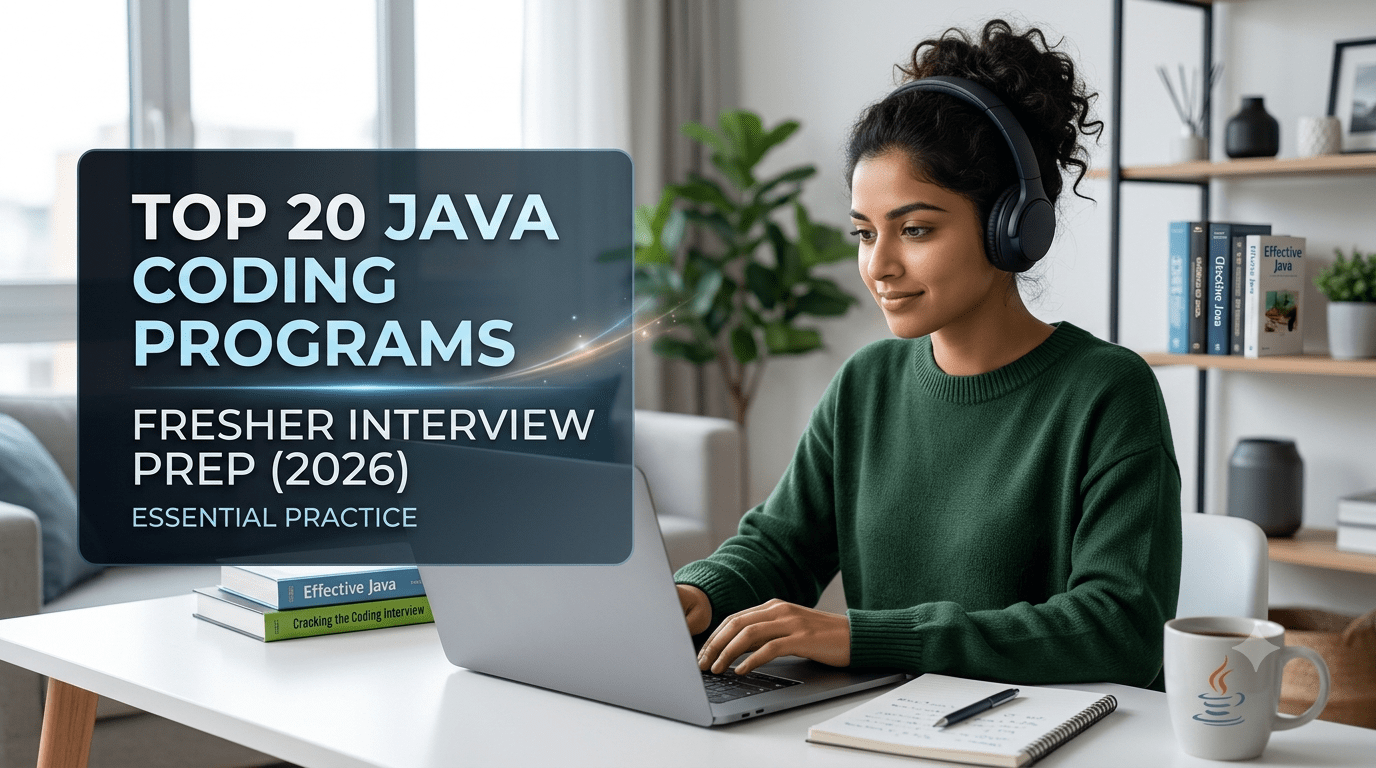
If you are searching for Java coding programs for freshers, Java coding interview questions with code, top Java programs for interview preparation 2026, Java coding practice for beginners, basic Java programs asked in interviews, or Java full stack developer interview coding questions, this guide is written to be the single most complete resource on the topic. Technical interviewers for fresher Java and full stack developer roles rely heavily on a fixed, predictable set of coding programs — not because they are especially difficult, but because they efficiently reveal whether a candidate can actually write working code under mild time pressure, not just recite definitions. This guide walks through 20 of the most frequently asked Java coding programs, organized by category, each with a complete, correct, ready-to-run code example and a clear explanation of the logic — plus a full, accurate, link-free profile of VibrantMinds Technologies and its Full Stack Java training program, so you can both practice and plan your next step in one place.
Why These 20 Coding Programs Matter So Much for Fresher Interviews
A large share of fresher technical interviews, coding rounds, and online assessments draw from a surprisingly narrow, repeating pool of coding problems. Interviewers use them because they are quick to evaluate, hard to bluff through, and reveal real programming fundamentals — loops, conditionals, string handling, array manipulation, and basic logic — faster than almost any theory question could.

• String-based programs are the single most frequently asked category in fresher Java interviews
• Array-based programs follow closely behind, testing iteration and in-place logic
• Number-based programs test mathematical and conditional logic fundamentals
• Searching, sorting, basic pattern, and simple OOP-based programs round out the remaining share, but are still asked often enough to require real preparation
Difficulty Level: What to Expect
Freshers often assume every coding round will be difficult. In reality, the majority of programs asked at the fresher level fall into the easy-to-medium range, provided you have actually practiced them rather than only read about them once:

Category 1: String Programs (Most Frequently Asked)
1. Reverse a String
One of the most commonly asked fresher Java programs, testing basic string and loop handling.
public class ReverseString {
public static void main(String[] args) {
String str = "VibrantMinds";
String reversed = "";
for (int i = str.length() - 1; i >= 0; i--) {
reversed += str.charAt(i);
}
System.out.println("Reversed String: " + reversed);
}
}
2. Check if a String Is a Palindrome
Tests whether you can compare a string with its reverse efficiently.
public class PalindromeString {
public static void main(String[] args) {
String str = "madam";
String reversed = new StringBuilder(str).reverse().toString();
if (str.equals(reversed)) {
System.out.println(str + " is a Palindrome");
} else {
System.out.println(str + " is not a Palindrome");
}
}
}
3. Check if Two Strings Are Anagrams
Tests your ability to sort or count characters and compare two collections.
import java.util.Arrays;
public class AnagramCheck {
public static void main(String[] args) {
String s1 = "listen";
String s2 = "silent";
char[] a1 = s1.toCharArray();
char[] a2 = s2.toCharArray();
Arrays.sort(a1);
Arrays.sort(a2);
boolean isAnagram = Arrays.equals(a1, a2);
System.out.println("Are Anagrams: " + isAnagram);
}
}
4. Count Vowels and Consonants in a String
A simple but effective way to test conditional logic combined with string traversal.
public class VowelConsonantCount {
public static void main(String[] args) {
String str = "VibrantMinds";
int vowels = 0, consonants = 0;
String vowelSet = "aeiouAEIOU";
for (int i = 0; i < str.length(); i++) {
char ch = str.charAt(i);
if (Character.isLetter(ch)) {
if (vowelSet.indexOf(ch) != -1) {
vowels++;
} else {
consonants++;
}
}
}
System.out.println("Vowels: " + vowels + ", Consonants: " + consonants);
}
}
Category 2: Array Programs
5. Find the Largest Element in an Array
public class LargestElement {
public static void main(String[] args) {
int[] arr = {12, 45, 3, 67, 29};
int max = arr[0];
for (int num : arr) {
if (num > max) max = num;
}
System.out.println("Largest Element: " + max);
}
}
6. Find the Second Largest Element in an Array
A common follow-up to the previous program, testing whether you can extend simple logic correctly.
public class SecondLargest {
public static void main(String[] args) {
int[] arr = {12, 45, 3, 67, 29};
int max = Integer.MIN_VALUE, second = Integer.MIN_VALUE;
for (int num : arr) {
if (num > max) {
second = max;
max = num;
} else if (num > second && num != max) {
second = num;
}
}
System.out.println("Second Largest Element: " + second);
}
}
7. Remove Duplicate Elements from an Array
import java.util.LinkedHashSet;
import java.util.Set;
public class RemoveDuplicates {
public static void main(String[] args) {
int[] arr = {1, 2, 2, 3, 4, 4, 5};
Set<Integer> unique = new LinkedHashSet<>();
for (int num : arr) {
unique.add(num);
}
System.out.println("Array Without Duplicates: " + unique);
}
}
8. Sort an Array Using Bubble Sort
A classic program used to test whether you understand nested loops and swapping logic, not just Java's built-in sort methods.
public class BubbleSort {
public static void main(String[] args) {
int[] arr = {5, 2, 9, 1, 5, 6};
int n = arr.length;
for (int i = 0; i < n - 1; i++) {
for (int j = 0; j < n - i - 1; j++) {
if (arr[j] > arr[j + 1]) {
int temp = arr[j];
arr[j] = arr[j + 1];
arr[j + 1] = temp;
}
}
}
for (int num : arr) System.out.print(num + " ");
}
}
Category 3: Number Programs
9. Check if a Number Is Prime
public class PrimeCheck {
public static void main(String[] args) {
int num = 29;
boolean isPrime = true;
if (num <= 1) isPrime = false;
for (int i = 2; i <= Math.sqrt(num); i++) {
if (num % i == 0) {
isPrime = false;
break;
}
}
System.out.println(num + " is Prime: " + isPrime);
}
}
10. Print the Fibonacci Series
public class FibonacciSeries {
public static void main(String[] args) {
int n = 10, a = 0, b = 1;
System.out.print("Fibonacci Series: ");
for (int i = 0; i < n; i++) {
System.out.print(a + " ");
int next = a + b;
a = b;
b = next;
}
}
}
11. Find the Factorial of a Number
public class Factorial {
public static void main(String[] args) {
int num = 6;
long factorial = 1;
for (int i = 1; i <= num; i++) {
factorial *= i;
}
System.out.println("Factorial of " + num + " = " + factorial);
}
}
12. Check if a Number Is an Armstrong Number
A frequently asked program that tests your ability to combine digit extraction with power calculation.
public class ArmstrongNumber {
public static void main(String[] args) {
int num = 153, sum = 0, temp = num;
int digits = String.valueOf(num).length();
while (temp != 0) {
int digit = temp % 10;
sum += Math.pow(digit, digits);
temp /= 10;
}
System.out.println(num + " is Armstrong: " + (sum == num));
}
}
13. Check if a Number Is a Palindrome
public class PalindromeNumber {
public static void main(String[] args) {
int num = 12321, original = num, reversed = 0;
while (num != 0) {
int digit = num % 10;
reversed = reversed * 10 + digit;
num /= 10;
}
System.out.println(original + " is Palindrome: " + (original == reversed));
}
}
Category 4: Logic and Pattern Programs
14. Swap Two Numbers Without Using a Third Variable
public class SwapNumbers {
public static void main(String[] args) {
int a = 5, b = 10;
a = a + b;
b = a - b;
a = a - b;
System.out.println("a = " + a + ", b = " + b);
}
}
15. Print a Pyramid Star Pattern
Pattern programs test your control over nested loops precisely — a skill that transfers directly to real-world formatting and rendering logic.
public class PyramidPattern {
public static void main(String[] args) {
int rows = 5;
for (int i = 1; i <= rows; i++) {
for (int j = 1; j <= i; j++) {
System.out.print("* ");
}
System.out.println();
}
}
}
16. Check if a Number Is an Armstrong Number Using a While Loop (Alternate Logic)
Interviewers sometimes ask you to solve the same problem a second way to test flexibility. This variant uses cumulative digit-power checks explicitly for clarity.
public class ArmstrongAlt {
public static void main(String[] args) {
int num = 9474, sum = 0, temp = num;
while (temp > 0) {
int digit = temp % 10;
sum += digit * digit * digit * digit;
temp /= 10;
}
System.out.println(num + " is Armstrong: " + (sum == num));
}
}
Category 5: Searching and Sorting
17. Linear Search
public class LinearSearch {
public static void main(String[] args) {
int[] arr = {4, 7, 1, 9, 3};
int target = 9;
int index = -1;
for (int i = 0; i < arr.length; i++) {
if (arr[i] == target) {
index = i;
break;
}
}
System.out.println("Element found at index: " + index);
}
}
18. Binary Search
Requires a sorted array, and tests whether you understand the divide-and-conquer approach rather than just linear iteration.
public class BinarySearch {
public static void main(String[] args) {
int[] arr = {1, 3, 5, 7, 9, 11};
int target = 7, low = 0, high = arr.length - 1;
int result = -1;
while (low <= high) {
int mid = (low + high) / 2;
if (arr[mid] == target) {
result = mid;
break;
} else if (arr[mid] < target) {
low = mid + 1;
} else {
high = mid - 1;
}
}
System.out.println("Element found at index: " + result);
}
}
Category 6: OOP-Based Programs
19. Simple Class and Object Example
Tests basic understanding of classes, objects, and constructors — the foundation of every larger Java full stack application.
class Student {
String name;
int age;
Student(String name, int age) {
this.name = name;
this.age = age;
}
void display() {
System.out.println("Name: " + name + ", Age: " + age);
}
}
public class StudentDemo {
public static void main(String[] args) {
Student s1 = new Student("Rahul", 22);
s1.display();
}
}
20. Method Overloading Example
Tests whether you understand polymorphism at a basic level — one of the most commonly asked OOP fundamentals in fresher interviews.
class Calculator {
int add(int a, int b) {
return a + b;
}
double add(double a, double b) {
return a + b;
}
int add(int a, int b, int c) {
return a + b + c;
}
}
public class OverloadDemo {
public static void main(String[] args) {
Calculator calc = new Calculator();
System.out.println(calc.add(2, 3));
System.out.println(calc.add(2.5, 3.5));
System.out.println(calc.add(1, 2, 3));
}
}
A 20-Day Coding Practice Plan
Spreading practice across categories, rather than cramming all 20 programs in one sitting, builds far stronger long-term recall:

• Days 1–4: String programs — practice each one from memory, then attempt a small variation of your own
• Days 5–8: Array programs — focus especially on largest/second-largest and duplicate-removal logic, which reappear constantly in different forms
• Days 9–13: Number programs — prime, Fibonacci, factorial, Armstrong, and palindrome checks, since these form the base for many follow-up logic questions
• Days 14–16: Searching and sorting — implement both manually at least twice without looking at reference code
• Days 17–18: Logic and pattern programs — these build the nested-loop control that interviewers often extend into live follow-up questions
• Days 19–20: OOP-based programs and full revision — attempt all 20 programs again from scratch, timing yourself
How to Practice These Programs the Right Way
• Write the code by hand or in a plain text editor first, without IDE auto-complete, since many interviews and online assessments don't offer auto-complete either
• After solving each program, explain your logic out loud as if talking to an interviewer — this builds the explanation skill separately from the coding skill
• Deliberately introduce a bug into your own working code, then debug it — this builds the same skill interviewers test when they ask you to find an error in provided code
• Once comfortable, try solving the same program using a different approach — for example, reversing a string using a StringBuilder instead of a manual loop
• Time yourself on familiar programs to build speed, since real coding rounds are almost always timed
Common Mistakes Freshers Make With These Programs
• Memorizing the code exactly as written here without understanding why each line works, which falls apart the moment an interviewer asks for a small modification
• Ignoring edge cases — an empty string, a single-element array, or a negative number — which interviewers frequently test deliberately
• Relying entirely on built-in Java methods (such as a reverse method) when an interviewer specifically asks for manual logic to test your fundamentals
• Skipping the explanation practice and only focusing on getting the code to compile, which leaves candidates unable to talk through their own solution clearly
VibrantMinds Technologies: Complete Course and Company Details
Strong coding fundamentals like the 20 programs above form the foundation of a genuine Java full stack skill set — and are exactly the kind of material covered in depth within a structured training program. VibrantMinds Technologies Pvt. Ltd. is a Pune-based IT training and placement company operating as a talent ecosystem connecting candidates, colleges, and hiring companies. The information below is drawn from VibrantMinds' own published course details; always confirm current fees, batch dates, and specific syllabus details directly with the institute before enrolling.
• VibrantMinds states partnerships with 1900+ colleges and 600+ companies across India
• The company operates across three core service areas: Campus Recruitment, Online Assessments, and IT Training Programs
• Training is delivered both at its Warje, Pune campus and through live online batches for freshers based in other cities
VibrantMinds Full Stack Java Course: Full Syllabus
|
Skill Area |
Topics Covered |
|
Core Java Foundations |
Object-oriented programming, data types, loops, arrays, collections — directly building the fundamentals behind the coding programs above |
|
Advanced Java |
Servlets, JDBC, multithreading, exception handling |
|
Frontend Basics |
HTML, CSS, and JavaScript fundamentals |
|
Spring Boot & REST APIs |
Spring core concepts, Spring Boot, and REST API development |
|
SQL & Databases |
Queries, joins, and database design basics |
|
Communication & Aptitude |
Spoken English, group discussion practice, and quantitative aptitude |
|
Interview Readiness |
Mock interviews, resume support, and live placement drive participation |
Other Courses Offered by VibrantMinds
• Software Testing — manual and automation testing fundamentals for QA-track freshers
• Core Java — a foundational track for complete beginners with no prior coding background at all
• Python & Data Science — foundational-to-intermediate coverage for freshers interested in data-adjacent career paths
• Placement-Focused Batches — technical training blended with dedicated soft-skill and interview coaching
How VibrantMinds Builds Coding Fundamentals Into Training
• Daily hands-on coding practice using real development tools such as Eclipse, NetBeans, and Git, rather than theory-only sessions
• Structured progression from basic programs — similar in spirit to the 20 covered in this guide — through to full application-level projects using Spring Boot and REST APIs
• Mock interviews built into the final phase of training specifically test candidates on foundational coding programs before pushing them into live company drives
• A six-stage placement process supports candidates from requirement mapping and candidate sourcing, through screening and assessment, drive coordination, interview support, and onboarding follow-up
VibrantMinds Contact Details
• Registered as: VibrantMinds Technologies Pvt. Ltd.
• Address: Viva Academy Building, Warje, Pune, Maharashtra 411052
• Phone: +91 95035 79517
• Email: support@vibrantmindstech.com
Frequently Asked Questions
Q: Are these 20 programs enough to clear a fresher coding round? They cover the large majority of commonly repeated patterns, but should be treated as a strong foundation to build on with additional practice, not a complete, exhaustive list.
Q: Should I memorize this code exactly? No — memorizing without understanding falls apart under a follow-up question or a slightly modified problem; focus on understanding the logic well enough to rebuild it from scratch.
Q: Which category should I prioritize if I only have one week to prepare? String and array programs, since they appear most frequently in fresher interviews and coding assessments, based on the frequency data above.
Q: Do interviewers expect the most optimized solution, or just a working one? For fresher-level interviews, a correct, clearly explained working solution is usually sufficient — optimization matters more at higher experience levels, though being able to discuss a more efficient approach is a genuine plus.
Q: Does VibrantMinds' Full Stack Java course cover these kinds of programs? Yes — Core Java foundations, covered early in the program, build directly on the same loop, array, and string logic used throughout the 20 programs in this guide.
Bottom Line
These 20 Java coding programs represent the practical, repeatable foundation that fresher technical interviews are built on — not obscure trick questions, but the fundamentals of loops, conditionals, strings, arrays, and basic object-oriented design. Practice each one until you can write it from scratch, explain your logic clearly out loud, and handle a small variation without panicking. That combination — correctness plus explanation plus adaptability — is what actually separates a strong fresher coding-round performance from a shaky one. A structured program like VibrantMinds Technologies' Full Stack Java course builds exactly this foundation, alongside the broader Spring Boot, REST API, and database skills that turn basic coding ability into a genuine, job-ready full stack skill set.