The Real Reasons Behind Coding-Round Rejections, Worked Code Examples for Each Fix, and How VibrantMinds Technologies Builds This Practice In
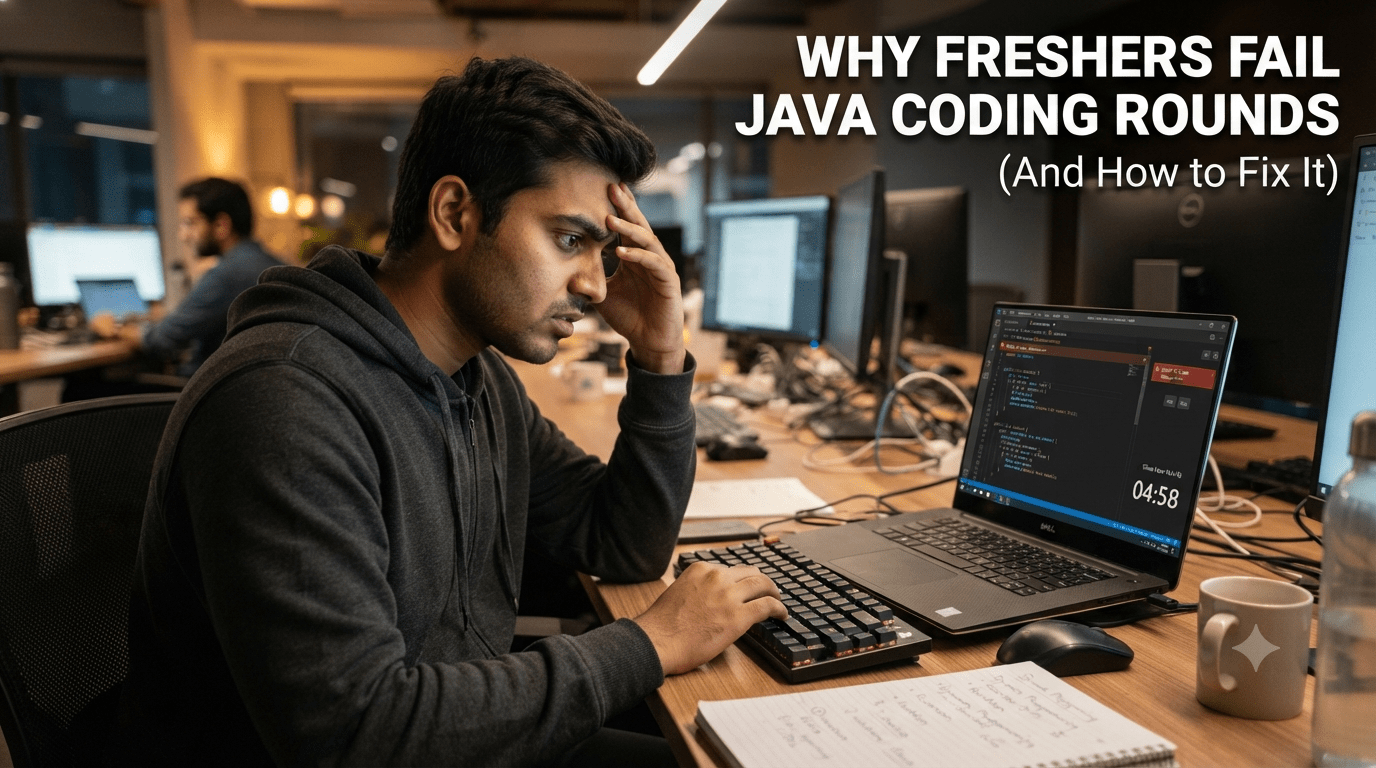
You studied Java properly. You know OOP, collections, loops, exception handling — you could explain all of it on a whiteboard without hesitation. And then the live coding round happens, and your mind goes blank on a problem that, looking back later, you could have solved in your sleep. If you are searching for why do I fail coding rounds despite knowing Java, why I freeze during technical interviews, live coding interview anxiety fresher, how to prepare for live coding rounds 2026, or Java coding interview practice routine, this is exactly the problem this guide is built to solve. The gap almost never comes down to not knowing Java. It comes down to a small number of very specific, fixable habits that no amount of passive studying trains you out of — and this guide walks through each one, with real code showing exactly what the fix looks like in practice, plus a full, accurate, promotion-forward profile of VibrantMinds Technologies and how its training program is built specifically around closing this exact gap.
The Real Reasons Freshers Fail Live Coding Rounds
Knowing Java and performing well in a live, timed coding round are genuinely different skills — and freshers who prepare only for the first one are consistently caught off guard by the second. The most common, specific failure patterns are:
|
Failure Pattern |
What's Actually Happening |
|
Freezing on a familiar problem |
You've read solutions, but never written one from a blank screen under time pressure |
|
Relying on IDE autocomplete |
Many live rounds use plain text editors or shared docs with no autocomplete, syntax highlighting, or error checking |
|
Coding in total silence |
Interviewers are evaluating your thinking process, not just your final answer — silence gives them nothing to assess |
|
Jumping straight into code |
Writing code before planning the approach leads to messy, hard-to-fix logic under time pressure |
|
Never testing edge cases |
A solution that works for the obvious case often breaks silently on an empty input, a single element, or a duplicate value |
|
Giving up when stuck |
Going silent or saying "I don't know" loses far more points than talking through a partial, imperfect approach |
Fix 1: Practice Writing Code From a Blank Screen, Not Just Reading It
Reading a solved problem creates a false sense of mastery — recognizing correct code is a completely different skill from producing it yourself under pressure. The fix is deceptively simple but rarely done properly: close every reference, set a timer, and write the full solution from nothing.
Worked Example: Find the First Non-Repeating Character in a String
This is a genuinely common live-round question. Here's what a blank-screen attempt should look like — plan first, in a comment, then code:
public class FirstNonRepeating {
public static void main(String[] args) {
String input = "swiss";
// Plan: count occurrences of each character first,
// then find the first one with a count of 1.
int[] count = new int[256];
for (char c : input.toCharArray()) {
count[c]++;
}
char result = '_';
for (char c : input.toCharArray()) {
if (count[c] == 1) {
result = c;
break;
}
}
System.out.println("First non-repeating character: " + result);
}
}
Practicing this way — plan as a comment, then code, timed, with no reference material — is what actually builds the blank-screen skill a real round demands.
Fix 2: Practice Without IDE Autocomplete at Least Once a Week
A large share of freshers only ever write Java inside a modern IDE that auto-suggests method names, flags syntax errors instantly, and formats code automatically. Real coding rounds — especially on shared-screen platforms or plain text editors — often strip all of that away, and the sudden loss of that safety net is a common, avoidable source of panic.
• Once a week, solve a familiar problem in a plain text editor (Notepad, a basic text file, or an online blank-editor tool) with no syntax highlighting and no autocomplete
• Deliberately practice recalling exact method names and syntax from memory — String.charAt(), ArrayList.add(), Collections.sort() — rather than relying on the IDE to suggest them
• This single habit removes a surprising amount of the panic freshers report in real, unfamiliar coding environments
Fix 3: Practice Narrating Your Logic Out Loud While You Code
Interviewers are explicitly evaluating your thought process, not only your final output — silence during a coding round gives an evaluator nothing to assess except a blank stare followed eventually by code. The fix is to practice speaking your reasoning as you type, every single time you practice, so it becomes automatic under real pressure.
What Narrating Actually Sounds Like (Written as Inline Comments)
public class NarratedExample {
public static void main(String[] args) {
int[] arr = {4, 2, 7, 1, 9};
// "I need the second largest element. My first thought is
// to sort the array, but that's O(n log n) — I can do this
// in a single pass instead, tracking both the largest and
// second largest as I go."
int max = Integer.MIN_VALUE, secondMax = Integer.MIN_VALUE;
for (int num : arr) {
if (num > max) {
secondMax = max;
max = num;
} else if (num > secondMax && num != max) {
secondMax = num;
}
}
// "That gives me an O(n) solution in a single loop."
System.out.println("Second Largest: " + secondMax);
}
}
Practicing with this kind of narration — even alone, out loud, while solving problems at home — trains the habit so it doesn't have to be consciously remembered under real pressure.
Fix 4: Plan Before You Code, Every Single Time
Freshers under pressure often start typing the moment they read a problem, without a clear plan — which frequently leads to messy logic that has to be scrapped and restarted midway, burning far more time than planning would have cost upfront.
A Simple Planning Template to Use Before Writing Any Code
• Restate the problem in your own words out loud, to confirm you understood it correctly
• Identify the input and expected output explicitly, including edge cases
• Sketch the approach in plain English or pseudocode comments before writing real syntax
• Only then start writing the actual code, following the plan you just laid out
// Problem: Check if two strings are anagrams of each other.
// Input: two strings. Output: true or false.
// Edge case: different lengths means they can't be anagrams.
// Plan: sort both strings' characters and compare.
import java.util.Arrays;
public class PlannedAnagramCheck {
public static void main(String[] args) {
String s1 = "listen", s2 = "silent";
if (s1.length() != s2.length()) {
System.out.println("Not Anagrams");
return;
}
char[] a = s1.toCharArray();
char[] b = s2.toCharArray();
Arrays.sort(a);
Arrays.sort(b);
System.out.println("Are Anagrams: " + Arrays.equals(a, b));
}
}
Fix 5: Always Test Edge Cases Before Declaring You're Done
A solution that handles the obvious example but breaks on an empty input, a single-element array, or duplicate values is one of the fastest ways to lose points in a coding round — and one of the easiest gaps to close with a simple habit.
Building Edge-Case Testing Into Your Practice
public class EdgeCaseTesting {
static int findMax(int[] arr) {
if (arr == null || arr.length == 0) {
throw new IllegalArgumentException("Array must not be empty");
}
int max = arr[0];
for (int num : arr) {
if (num > max) max = num;
}
return max;
}
public static void main(String[] args) {
System.out.println(findMax(new int[]{3, 7, 2})); // normal case
System.out.println(findMax(new int[]{5})); // single element
// findMax(new int[]{}); // empty array - handled explicitly
}
}
Simply asking yourself "what happens with zero elements, one element, or repeated values?" before declaring a solution finished catches a large share of the bugs that live coding rounds are specifically designed to expose.
Fix 6: Talk Through Partial Logic Instead of Going Silent When Stuck
Every candidate gets stuck sometimes — what separates a strong performance from a weak one is what happens next. Freshers who go quiet or say "I don't know" give the interviewer nothing to evaluate. Freshers who talk through what they've tried, why it isn't working, and what they'd try next, consistently score better, even when they don't fully solve the problem.
• Say what you know for certain about the problem, even if you're unsure how to finish it
• Mention an approach you're considering, even a partial or possibly inefficient one, rather than staying silent
• Ask a clarifying question if you're genuinely unsure about a constraint — this is normal and expected, not a weakness
• Practicing this specifically, in mock settings, is the only way it becomes natural rather than forgotten under real pressure
A Complete Worked Example: Solving a Problem the Right Way, Start to Finish
Putting all five fixes together — planning, narrating, blank-screen writing, and edge-case testing — on a genuinely common live-round question:
Problem: Reverse the Words in a Sentence
// Problem: Given a sentence, reverse the order of the words.
// Input: "Java is fun" -> Output: "fun is Java"
// Edge cases: multiple spaces, single word, empty string.
// Plan: split on spaces, reverse the array of words, rejoin.
public class ReverseWordsInSentence {
public static void main(String[] args) {
String sentence = "Java is fun";
String[] words = sentence.trim().split("\\s+");
StringBuilder result = new StringBuilder();
for (int i = words.length - 1; i >= 0; i--) {
result.append(words[i]);
if (i != 0) result.append(" ");
}
System.out.println(result.toString());
// Tested: single word "Java" -> returns "Java" correctly
// Tested: empty string -> returns empty string, no crash
}
}
Notice the structure: the plan is written first as a comment, the code follows it directly, and edge cases are explicitly noted as tested rather than assumed. This is the exact pattern worth rehearsing until it becomes automatic.
A Practice Routine to Build These Habits Before Your Next Interview
|
Practice Session |
What to Do |
|
3x per week, 30 minutes |
Solve one familiar problem from a blank screen, no reference material, narrating your approach out loud the entire time |
|
1x per week |
Solve one problem in a plain text editor with no autocomplete or syntax highlighting |
|
Every session |
Write your plan as a comment before writing any real code, no exceptions |
|
Every session |
Explicitly test at least one edge case before considering the problem finished |
|
1x per week |
Attempt one problem you can't immediately solve, and practice talking through partial logic instead of giving up silently |
How VibrantMinds Technologies Builds This Exact Practice Into Training
This specific gap — knowing Java in theory but freezing in a live, evaluated coding round — is precisely what a genuinely hands-on training program is built to close, and it's worth being direct about how VibrantMinds Technologies approaches it. VibrantMinds Technologies Pvt. Ltd. is a Pune-based IT training and placement company, and its Full Stack Java program is structured around daily, hands-on coding practice rather than passive, lecture-only learning — which is exactly the difference between freshers who freeze in real coding rounds and freshers who don't.
• Daily coding practice, built into the program from day one, using real development tools like Eclipse, NetBeans, and Git — not just watching solved examples on a screen
• Live projects require students to actually plan, write, and debug real code under guidance, building the blank-screen habit long before any real interview happens
• A dedicated interview-readiness phase includes mock technical interviews specifically designed to simulate the pressure, pacing, and evaluation style of real coding rounds
• Trainers actively push students to explain their logic out loud during practice sessions, directly building the narration habit covered in this guide
• The six-stage placement pipeline — requirement mapping, candidate sourcing, screening and assessment, drive coordination, interview support, and onboarding follow-up — means candidates aren't just trained in isolation, but pushed into real, live company drives where these exact skills get tested for real
VibrantMinds Full Stack Java Course: Complete Syllabus
|
Skill Area |
Topics Covered |
|
Core Java Foundations |
Object-oriented programming, data types, loops, arrays, collections |
|
Advanced Java |
Servlets, JDBC, multithreading, exception handling |
|
Frontend Basics |
HTML, CSS, and JavaScript fundamentals |
|
Spring Boot & REST APIs |
Spring core concepts, Spring Boot, and REST API development |
|
SQL & Databases |
Queries, joins, and database design basics |
|
Communication & Aptitude |
Spoken English, group discussion practice, and quantitative aptitude |
|
Interview Readiness |
Mock interviews built around real coding-round pressure, resume support, and live placement drive participation |
The program typically runs 4 to 6 months, depending on the batch, and is delivered both at VibrantMinds' Warje, Pune campus and through live online batches, so freshers outside Pune can access the identical hands-on training and placement pipeline.
Other Courses Offered by VibrantMinds Technologies
• Software Testing — manual and automation testing fundamentals for freshers targeting QA-track roles
• Core Java — a foundational track for complete beginners with no prior coding background at all
• Python & Data Science — foundational-to-intermediate coverage for freshers interested in data-adjacent career paths
• Placement-Focused Batches — technical training blended with dedicated soft-skill, aptitude, and interview coaching
The VibrantMinds Six-Stage Placement Process
• Requirement Mapping — understanding each hiring company's specific role, required skills, and hiring timeline
• Candidate Sourcing — drawn from VibrantMinds' internal candidate portal, trained talent pool, and network across 1900+ colleges
• Screening & Assessment — aptitude and technical tests, plus group discussion rounds where relevant, mirroring the real pressure this guide addresses
• Drive Coordination — scheduling and running the actual recruitment drive, with candidate updates communicated throughout
• Interview Support — coordination between the hiring company and candidates through every round, including live technical coding rounds
• Onboarding Follow-up — continued contact with selected candidates until they have actually joined the company
Why This Structured Approach Produces Different Outcomes
A fresher who studies Java independently, from videos and books alone, can absolutely learn the language — but rarely gets the repeated, evaluated, time-pressured practice that a live coding round actually demands, simply because that kind of practice is hard to arrange alone. A structured program that builds daily hands-on coding, narrated problem-solving, and simulated interview pressure directly into its curriculum closes exactly the gap this guide has walked through, rather than leaving a fresher to discover it the hard way, in a real interview, when it's too late to fix.
VibrantMinds Contact Details and Website
• Registered as: VibrantMinds Technologies Pvt. Ltd.
• Address: Viva Academy Building, Warje, Pune, Maharashtra 411052
• Phone: +91 95035 79517
• Email: support@vibrantmindstech.com
Official Website: https://vibrantminds.in/
Candidate Portal & Courses: https://candidates.vibrantminds.in/
Frequently Asked Questions
Q: I know Java well but still fail live coding rounds. What's actually wrong? Almost certainly not your Java knowledge itself — it's most often one of the specific habits covered in this guide: lack of blank-screen practice, silent problem-solving, or skipping edge-case testing.
Q: How long does it take to fix these habits? With consistent, deliberate practice — three structured sessions a week, following the routine in this guide — most freshers notice a real difference within three to four weeks.
Q: Should I always narrate my thinking out loud, even in a written online assessment? For live, human-evaluated rounds, yes, consistently. For fully automated online tests with no interviewer present, narration matters less, but planning before coding and testing edge cases still apply equally.
Q: Is it normal to get stuck during a real coding round? Yes, completely normal, even for strong candidates — what matters is how you handle it, which is exactly why practicing partial-logic narration in advance makes such a measurable difference.
Q: Does VibrantMinds' training specifically address this coding-round freezing problem? Yes — daily hands-on coding practice and mock technical interviews built around real coding-round pressure are core parts of its Full Stack Java program's interview-readiness phase.
Bottom Line
Failing a live coding round after genuinely learning Java is rarely a knowledge problem — it's almost always a practice-format problem. You've trained yourself to recognize correct code, not to produce it, alone, under pressure, while explaining your thinking. Fix that specific gap deliberately: practice from a blank screen, narrate your logic, plan before you code, test edge cases, and talk through partial answers instead of going silent. If you want this built directly into a structured curriculum rather than assembled alone, VibrantMinds Technologies' Full Stack Java program, detailed in full above, is built around exactly this kind of daily, hands-on, pressure-tested coding practice.